Product Overview
Reliable custom rubber parts for industrial applications
Quick Answer
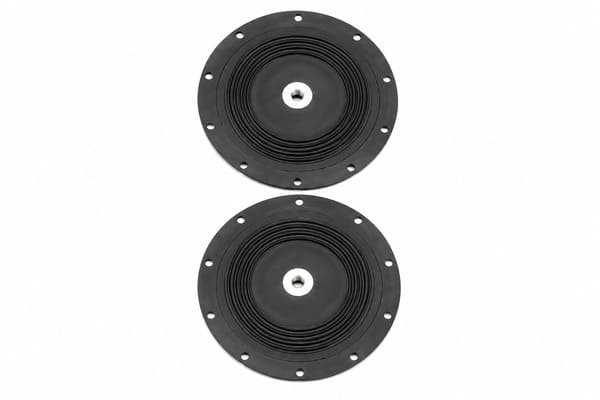
The 14003167 composite rubber diaphragm provides flexible chamber separation and pressure-responsive movement within its specified equipment assembly. Exact dimensions, rubber compound, reinforcement or insert structure, Shore A hardness, mounting features, tolerances, and compatibility are available upon request and require technical confirmation.
The 14003167 composite rubber diaphragm is an application-specific flexible component identified by part number 14003167. Its composite construction is intended to combine rubber flexibility with additional structural support specified for the assembly. Exact dimensions, constituent materials, Shore A hardness, reinforcement structure, operating conditions, and equipment compatibility are available upon request and must be confirmed before ordering.
Composite Rubber Diaphragm — Direct-Fit Replacement Component
The 14003167 composite rubber diaphragm is a multi-layer flexible membrane, typically combining a fabric-reinforced rubber backing with a chemical-resistant facing layer, engineered to replace a specific OEM diaphragm part carrying this reference number in a pump, valve, or actuator assembly. Composite construction of this type is used when a single elastomer cannot meet both the chemical resistance and mechanical flexibility demands of an application, so a resistant layer (such as PTFE or a specialty elastomer) is bonded to a flexible, fatigue-resistant backing (commonly EPDM, NBR, or Hypalon) during molding. Because part number 14003167 refers to a specific manufacturer’s catalog entry, exact dimensions, bolt pattern, and compatible equipment models should be confirmed against the original OEM documentation or a physical sample before ordering a replacement.
Key Specifications
| Parameter | Typical Range/Option |
|---|---|
| Part Number | 14003167 |
| Construction | Composite/multi-layer — resistant facing layer bonded to reinforced elastomer backing |
| Typical Backing Materials | EPDM, NBR, Hypalon (CSM), Neoprene |
| Typical Facing Layer | PTFE or specialty elastomer, depending on process fluid compatibility |
| Reinforcement | Fabric-reinforced (nylon or polyester) within the backing layer |
| Diaphragm Shapes | Flat, dished, or convoluted, depending on original equipment design |
| Attachment Feature | Center hole, bonded stud, or bolt-hole flange, matched to original part |
| Manufacturing Process | Compression molding, transfer molding, or layer bonding/vulcanizing |
What Is a Composite Rubber Diaphragm?
A composite rubber diaphragm combines two or more material layers into a single molded component, typically pairing a highly chemical-resistant but less flexible material on the process-contact side with a more flexible, fatigue-resistant elastomer on the backing side. This layered approach allows the diaphragm to handle aggressive or incompatible process fluids on one face while still achieving the repeated flexing performance needed for reliable pump, valve, or actuator operation on the other. Part number 14003167 identifies a specific composite diaphragm design cataloged by its original manufacturer, and sourcing an exact or compatible replacement typically requires matching this number against the manufacturer’s parts catalog or supplying a physical sample for reverse-engineering.
Why Composite Construction Is Used
- Chemical resistance without sacrificing flexibility — a resistant facing layer (such as PTFE) protects against aggressive fluids while the backing elastomer provides the flex characteristics a single resistant material often cannot achieve alone.
- Extended service life in mixed-media environments — composite designs perform well when one side of the diaphragm contacts process fluid while the other contacts a different medium, such as hydraulic oil or compressed air.
- Cost efficiency — using a thin resistant facing layer instead of manufacturing the entire diaphragm from an expensive specialty compound can reduce material cost while maintaining necessary performance.
- Application-specific engineering — composite construction allows a diaphragm to be tailored precisely to the chemical and mechanical demands of its specific installation rather than relying on compromise properties from a single material.
Sourcing a Replacement for Part 14003167
- Cross-reference verification — confirm the exact equipment brand, model, and original diaphragm specification associated with part number 14003167 before ordering, since part numbering systems vary between manufacturers.
- Sample-based reverse engineering — if catalog data is unavailable, providing a physical sample of the original diaphragm allows a manufacturer to measure diameter, thickness, layer construction, and attachment features for an accurate replacement.
- Layer material confirmation — verify both the facing layer and backing layer materials used in the original part, since substituting an incompatible material on either layer can compromise chemical resistance or flex life.
- Dimensional and attachment matching — outer diameter, bolt-hole pattern (if flanged), center attachment style, and overall thickness must all match the original design for correct fit and sealing.
Manufacturing Process
Composite diaphragms are produced by bonding a resistant facing layer to a fabric-reinforced elastomer backing during the molding process, using heat and pressure to cure the assembly into a single, permanently bonded component. Achieving a strong, void-free bond between dissimilar materials—such as PTFE and an elastomer backing—requires precise control of surface preparation, bonding agents, cure temperature, and pressure, since any delamination between layers represents a likely failure point under repeated flexing. Dimensional tolerances on diameter, thickness, and attachment features are held tightly to ensure the finished composite diaphragm matches the original equipment’s fit and sealing requirements.
Common Applications for Composite Diaphragms
- Diaphragm pumps and valves handling aggressive or corrosive process chemicals.
- Applications where the diaphragm separates two different media, such as hydraulic oil on one side and process fluid on the other.
- Pressure regulators and control valves requiring both chemical resistance and long-term flex durability.
- Industrial process equipment where a single elastomer cannot meet the full range of chemical and mechanical demands.
Custom Manufacturing Options
- Prototype and low-volume sampling available prior to full production tooling commitment.
- Custom replication of part number 14003167 based on OEM specification data or a physical sample.
- Custom facing layer and backing material selection based on confirmed process fluid compatibility.
- Custom fabric reinforcement type and ply count within the backing layer.
- Custom diameter, thickness, and attachment configuration to match the original equipment exactly.
FAQ
What materials are used in the 14003167 diaphragm?
The exact rubber compound and composite materials have not been provided. They are available upon request and must be confirmed from the approved specification, original equipment documentation, or verified sample. The reinforcement or insert material should not be assumed from the product name alone.
Does part number 14003167 confirm equipment compatibility?
The part number is an important reference, but the equipment model, revision, installation position, and technical dimensions should also be verified. Components with similar references or appearances may have different profiles, materials, mounting features, or tolerances.
Can an existing diaphragm be reproduced from a sample?
A physical sample can support dimensional and structural evaluation. Application information and material requirements should also be provided. Wear, swelling, hardening, cracking, delamination, or permanent deformation may cause a used sample to differ from its original specification.
Are prototype samples available?
Sample availability depends on the confirmed geometry, composite construction, tooling requirements, and requested quantity. Initial samples can be arranged after technical review. Dimensions, material, installation fit, sealing areas, movement, and functional acceptance criteria should be defined before approval.
Is tooling required?
Tooling requirements depend on whether suitable tooling already exists and whether the requested product matches the confirmed 14003167 specification. New tooling may be required for a different membrane profile, mounting structure, composite arrangement, or dimensional requirement.
How are MOQ and lead time confirmed?
MOQ and lead time depend on the product dimensions, constituent materials, composite construction, tooling status, inspection requirements, sample approval process, and order quantity. These details are available after the complete technical specification and estimated annual volume are reviewed.
Request a Custom Quote
Send the equipment model, part-number reference, 2D drawing, 3D model, or physical sample for review. Include dimensions, composite-material requirements, contact media, temperature, pressure, movement conditions, quantity, and estimated annual volume. Tooling, samples, MOQ, lead time, inspection, and documentation will be confirmed after technical evaluation.