Product Overview
Reliable custom rubber parts for industrial applications
Quick Answer
Custom silicone umbrella check valves control the one-way flow of compatible liquids or gases. Overall diameter, sealing-lip profile, stem geometry, silicone compound, Shore A hardness, color, tolerance, and pressure requirements can be developed for the specified valve seat and operating conditions.
Silicone umbrella check valves are flexible one-way valve components used to control compatible liquid or gas flow. Their umbrella-shaped sealing lip opens under a specified forward pressure and returns against the valve seat to restrict reverse flow. Valve diameter, stem geometry, lip thickness, silicone hardness, color, and operating requirements can be customized.
Custom Silicone Umbrella Check Valves for One-Way Flow Control
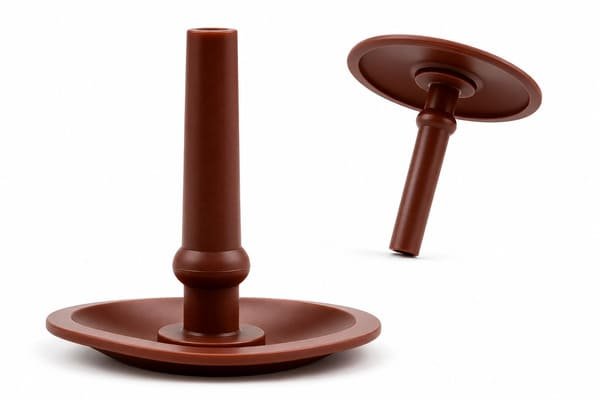
A silicone umbrella check valve, also known as a mushroom valve, is a one-way elastomeric valve featuring a diaphragm-shaped sealing disk mounted on a central stem, designed to allow fluid or gas to flow in one direction while sealing tightly against backflow in the opposite direction. When mounted in a seat, the convex diaphragm flattens against the valve seat to absorb minor surface irregularities and create sealing force, then lifts away from the seat once forward flow pressure exceeds a predetermined cracking pressure, immediately resealing when that pressure drops. These valves are widely used across medical devices, automotive fuel systems, packaging, appliances, and toys because they combine a simple one-piece design with low cost, high durability, and reliable backflow prevention.
Key Specifications
| Parameter | Typical Range/Option |
|---|---|
| Material | Silicone rubber, LSR (Liquid Silicone Rubber), fluorosilicone (FVMQ) |
| Hardness | Generally under 55 Shore A, depending on umbrella hook design (range 30–90 Shore A available) |
| Temperature Range | -40°C to 230°C (some grades -60°C to 230°C) |
| Cracking Pressure | Approx. 0.3–10.0 mbar, fully customizable |
| Color Options | Natural, white, transparent, or custom colors |
| Certifications | FDA, LFGB, ISO 9001, ISO 13485, RoHS, CE |
| Manufacturing Process | Compression molding or LSR injection molding |
| Sample Availability | Custom samples typically available, 5–7 day lead time |
What Is a Silicone Umbrella Check Valve?
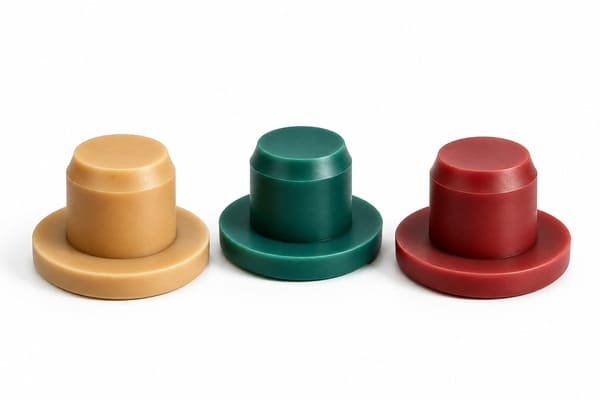
An umbrella check valve gets its name from its shape: a flexible dome or “umbrella” cap sits atop a central stem, which passes through a mounting hole in a plastic or metal panel to hold the valve in place without requiring a spring or separate positioning component. Forward flow pressure lifts the umbrella cap’s edge away from the seat, allowing fluid or gas to escape around its perimeter, while any reverse pressure pushes the cap back down flat against the seat to form an immediate, position-independent seal. This self-contained, single-piece design distinguishes umbrella valves from spring-loaded disc check valves, since the silicone’s own elasticity and preloaded convex shape generate the sealing force rather than a mechanical spring.
Key Design Advantages
- Immediate positive seal — the elastic diaphragm reseals instantly once forward pressure drops below the cracking threshold, preventing backflow without delay.
- Position independent operation — because sealing relies on elastic memory rather than gravity or a spring, the valve functions correctly in any mounting orientation.
- Variable, tunable cracking pressure — adjusting seat thickness and stem/diaphragm geometry allows the opening pressure to be precisely tuned, often within a 0.3–10.0 mbar range.
- High flow rate relative to size — the umbrella shape allows a large open flow area around its perimeter relative to the valve’s compact footprint.
- Corrosion and wear resistant — silicone’s chemical stability avoids the corrosion issues associated with metal spring-based check valves.
- Simplified assembly — a single molded part eliminates the need for a spring, disc positioner, or other assembly components, reducing cost and part count.
Material Options and Properties
| Material | Key Properties | Typical Use Case |
|---|---|---|
| Silicone rubber (general) | High elasticity, FDA/medical grade options, -40°C to 230°C range | Medical devices, food/beverage packaging, general one-way flow control |
| LSR (Liquid Silicone Rubber) | Withstands extreme temperatures without property change, supports autoclave sterilization | Medical devices requiring repeated high-heat sterilization |
| Fluorosilicone (FVMQ) | Strong resistance to oils, fuels, and strong acids/alkalis/oxidants; same wide temperature range as silicone | Automotive fuel systems, hydraulic fluid contact |
| EPDM | Excellent ozone, weather, and heat aging resistance | Outdoor and weather-exposed applications |
| Buna N / Nitrile | Strong oil resistance | Oil pump and engine applications |
Silicone is generally considered the best base material for umbrella valves due to its combination of high elasticity and low compression set, while fluorosilicone is the preferred substitute whenever the valve will contact fuel oil or hydraulic fluid.
Sizing and Design Parameters
| Design Feature | Guideline |
|---|---|
| Umbrella cap diameter | Sized larger than the one-way valve hole it covers |
| Hook height | Matched to the thickness of the plastic or metal mounting panel |
| Stem diameter | Equal to or slightly smaller than the assembly mounting hole |
| Outer diaphragm surface | EDM-processed or textured finish to resist dust accumulation |
| Inner sealing ring edge | Polished or high-polished finish to maximize sealing performance |
Both stem diameter and hook height must be matched precisely to the mounting hardware, since an oversized stem can prevent proper seating while an undersized hook height can allow the valve to detach under flow pressure.
Manufacturing Process
Silicone umbrella check valves are produced primarily through LSR injection molding or compression molding, where liquid or high-consistency silicone rubber is cured under heat and pressure into a mold cavity that forms the umbrella cap, stem, and sealing ring geometry in a single operation. Precision control over the inner diaphragmatic ring edge is critical, as this surface is typically polished to a high finish to maximize sealing contact against the valve seat, while the outer surface may instead be textured to resist dust buildup. Because cracking pressure is determined largely by seat/diaphragm thickness and geometry, mold tooling must be engineered precisely to achieve a specific, repeatable opening pressure across a full production run.
Common Applications
- Medical devices, including manual resuscitators, respirators, anesthesia apparatus, and surgical equipment.
- Automotive fuel tank vent valves and engine/oil pump one-way flow control.
- Inlet and outlet valves for piston and diaphragm pumps.
- Disposable breathing mask one-way check valves.
- Food and beverage packaging, including flavor-control valves in water bottles that prevent liquid backflow and dilution.
- Household appliances and consumer product one-way flow or pressure relief functions.
- General industrial vent valves and pressure relief valves in machinery.
Custom Manufacturing Options
- Custom umbrella cap diameter, stem diameter, and hook height to match a specific mounting panel and hole design.
- Custom cracking pressure tuning, typically within a 0.3–10.0 mbar range, through seat thickness adjustment.
- Custom material selection (silicone, LSR, fluorosilicone, EPDM, nitrile) based on fluid compatibility and temperature requirements.
- Custom color options, including natural, white, transparent, or specified pigments.
- Custom logo molding for OEM branding.
- FDA, LFGB, and medical-grade certification packages available on request.
- Free or low-cost samples typically available for evaluation before full production orders.
FAQ
Can the dimensions of a silicone umbrella check valve be customized?
Yes. The overall diameter, umbrella curvature, lip thickness, stem diameter, stem length, mounting interface, and retaining features can be customized. A complete drawing, 3D model, physical sample, or valve assembly should be provided to confirm the dimensional relationship between the silicone valve and its seat.
What determines the cracking pressure?
Cracking pressure depends on the umbrella diameter, lip thickness, lip profile, silicone hardness, material elasticity, valve-seat geometry, flow-hole arrangement, mounting condition, temperature, and contact medium. The required pressure and test method should be specified before the valve design and compound are approved.
Can an umbrella valve prevent all reverse leakage?
Zero leakage should not be assumed. Reverse-flow performance depends on the sealing-lip geometry, valve-seat flatness and finish, contamination, pressure, temperature, material condition, and assembly accuracy. Buyers should define the allowable leakage rate, reverse pressure, medium, test duration, and acceptance method.
How should the silicone compound and hardness be selected?
Material selection depends on the contact medium, operating temperature, pressure cycle, required flexibility, cracking pressure, compression behavior, and compliance requirements. Shore A hardness also affects opening force and sealing contact. The final compound should be confirmed through testing in the intended valve assembly.
Are samples available for functional testing?
Sample availability depends on the valve dimensions, silicone compound, hardness, color, tooling status, and requested quantity. Samples can be discussed after technical review. Testing should cover installation, cracking pressure, flow rate, reverse leakage, temperature exposure, media compatibility, and repeated operating cycles.
How are tooling, MOQ, and lead time confirmed?
Tooling, MOQ, and lead time depend on the valve geometry, silicone compound, dimensional tolerances, pressure requirements, test plan, inspection criteria, packaging, and order quantity. These details are confirmed after reviewing the complete specification, valve-seat design, sample requirements, and estimated annual volume.
Request a Custom Quote
Send your 2D drawing, 3D model, physical sample, or valve assembly information for a custom quotation. Include the required dimensions, silicone compound, Shore A hardness, cracking pressure, reverse pressure, leakage limit, flow rate, temperature, contact medium, quantity, and estimated annual volume. Tooling, samples, MOQ, testing, and lead time will be confirmed after review.