Product Overview
Reliable custom rubber parts for industrial applications
Quick Answer
Intercooler-to-throttle-body rubber coupler sleeve manufactured from specified ACM rubber for an automotive charge-air line. The shaped component has a confirmed finished weight of 31 g. Connection dimensions, hardness, tolerances, color, tooling, samples, and packaging are available upon request.
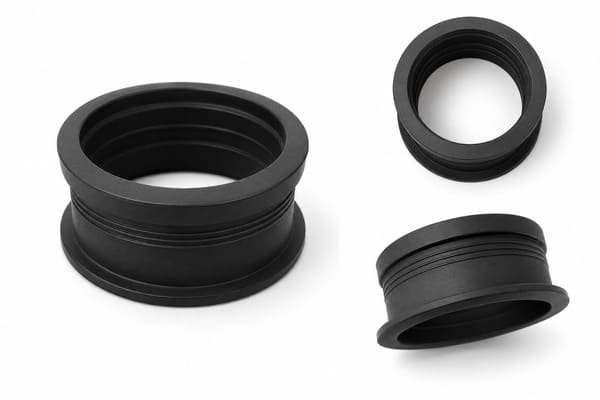
This intercooler-to-throttle-body rubber coupler sleeve is an ACM rubber connection component for an automotive charge-air line. It has a short shaped body with enlarged end sections and circumferential surface features. The finished part weighs 31 g, while the specified material charge weighs 36 g. Interface dimensions and hardness are available upon request.
Intercooler-to-Throttle-Body Rubber Coupler Sleeve, ACM Material
This is a molded rubber coupler sleeve, assembly number 1109450-QD01 with product drawing number CCYD-GJ-3031, designed to seal and connect the intercooler-to-throttle-body air line assembly in a turbocharged engine intake system. Molded from ACM (acrylic rubber) compliant with the internal JF01-1017 material standard, this sleeve is built to withstand the hot, oil-laden charge air environment found between the intercooler and throttle body.
Component Overview
| Parameter | Specification |
|---|---|
| Assembly Name | Intercooler to Throttle Body Line Assembly |
| Assembly Drawing Number | 1109450-QD01 |
| Product Name | Rubber Coupler Sleeve |
| Product Drawing Number | CCYD-GJ-3031 |
| Material | ACM, per internal standard JF01-1017 (inner layer) |
| MOQ | 10000pcs |
| Molded Weight | 31 grams |
| Blank/Raw Charge Weight | 36 grams |
| SOP Timing | Program year 2022, mass production 2022 |
Dimensional Specifications
| Feature | Value | Tolerance |
|---|---|---|
| Overall outer diameter | Φ 72.0 | — |
| Upper sealing groove diameter | Φ 57.6 | ±0.2 (positional/profile) |
| Upper flange thickness | 1.7 | ±0.2 (positional/profile) |
| Outer body diameter (mid-section) | Φ 68.0 | ±0.3 |
| Top land width | 2.5 | — |
| Overall height | 36.0 | — |
| Upper step height | 32.5 | — |
| Mid step height | 25.2 | — |
| Lower step height | 23.9 | — |
| Base reference height | 20 | — |
| Right-side vertical reference | 32 | ±0.2 |
| Upper corner radius (2 places) | R1.0 | — |
| Upper corner radius (alt.) | R0.5 | — |
| Right shoulder radius | R1 | — |
| Right shoulder radius (lower) | R1.5 | — |
| Bore diameter, smallest (top ID) | Φ 52 | — |
| Bore diameter, step 2 | Φ 55 | — |
| Bore diameter, step 3 | Φ 55.9 | — |
| Bore diameter, largest (bottom ID) | Φ 59.0 | — |
| Upper included angle | 51° | — |
| Lower included angle (outer) | 30° | — |
| Lower included angle (inner) | 123° | — |
| Unspecified fillet radius | R0.5 | Default per note 7 |
Technical Requirements (Notes)
- Material: ACM, per JF01-1017 (inner rubber layer).
- Unspecified dimensional tolerances follow JF01-1100, Table 1, Grade B.
- Prohibited automotive substances comply with Q/CAM-266-2017.
- Parts must be clean and free of contaminants during transport.
- End face must be marked with “>ACM<“.
- Unspecified dimensions refer to 3D data.
- Unspecified fillet radii default to R0.5.
Why ACM Rubber for This Application
ACM, or polyacrylate rubber, is selected for intercooler-to-throttle-body sleeves because the charge air path in a turbocharged system regularly encounters residual engine oil vapor and elevated post-compression air temperatures. ACM offers outstanding resistance to hot oil and oxidation, along with a continuous working temperature typically rated around 150 degrees Celsius and intermittent peaks up to 175 to 180 degrees Celsius, making it well suited to the thermal and chemical conditions found downstream of the turbocharger and intercooler. Many automotive charge-air hoses use ACM either as the entire coupler body or as an inner liner layer bonded to an outer silicone rubber structure, combining ACM’s oil resistance on the air-contact surface with silicone’s flexibility and weather resistance on the exterior.
Key Material Properties of ACM Rubber
- Continuous service temperature typically rated around 150 degrees Celsius, with intermittent tolerance up to 175 to 180 degrees Celsius, suited to hot charge-air environments.
- Strong resistance to hot oil, oxidation, and ozone, protecting the sleeve from degradation caused by residual oil mist in the intake charge path.
- Hardness typically available in a range of approximately 45 to 85 Shore A, allowing the compound to be tuned for the specific sealing and flexing requirements of this coupler.
- Tensile strength up to approximately 20 MPa and elongation at break up to approximately 450 percent in general-purpose ACM formulations, supporting durability under repeated thermal cycling and vibration.
- Lower cold-temperature flexibility compared to silicone, with standard ACM grades generally rated down to around negative 15 to negative 30 degrees Celsius, an important consideration when specifying material for cold-climate vehicle applications.
Function Within the Assembly
This coupler sleeve sits within the intercooler-to-throttle-body line assembly, forming a flexible, clamped connection point between two rigid ducting sections carrying compressed, cooled intake air from the intercooler into the throttle body. The rubber sleeve absorbs vibration, accommodates minor misalignment between mating components, and maintains an airtight seal under the pressure generated by the turbocharging system. Because this connection sits directly in the boosted air path, any leak or material failure at this sleeve can directly reduce boost pressure and engine performance, making material selection and dimensional accuracy critical to the part’s function.
Manufacturing Specifications
- Each unit is molded to a target finished weight of 31 grams from a raw material blank charge of 36 grams, reflecting the material lost to flash and trimming during the molding process.
- One sleeve is used per vehicle in this specific application, positioned at a single point in the intercooler-to-throttle-body line.
- The part is documented under a formal engineering change and drawing control system, with the finished product’s material call-out referencing the internal JF01-1017 standard specifically for the inner layer composition.
- Program timing indicates the assembly reached start of production status within program year 2022, with the associated drawing revision aligned to that production timeline.
Common Applications
- Turbocharged and supercharged engine intake systems requiring a flexible, oil-resistant connector between the intercooler outlet and throttle body inlet.
- Original equipment manufacturing (OEM) automotive supply programs requiring parts built to documented material and drawing standards for traceability.
- Aftermarket and replacement part manufacturing for vehicles where the factory intercooler-to-throttle-body coupler has degraded due to heat or oil exposure over time.
- Custom rubber bushing and sleeve applications requiring vibration absorption and shock isolation between two rigid ducting or piping sections in an engine bay.
Frequently Asked Questions
What are the dimensions of this rubber coupler sleeve?
The overall length, connection diameters, wall thickness, end-profile dimensions, rib geometry, and tolerances were not provided. They are available upon request. Complete dimensions should be confirmed from the mating intercooler and throttle-body line interfaces before tooling, sampling, or production.
Why is ACM specified for this coupler sleeve?
ACM is the confirmed rubber material for this component. Its suitability must still be evaluated against the actual temperature, internal pressure, pulsation, oil or condensate exposure, environmental conditions, and required service life. No specific performance limit should be assumed without the complete compound specification and validation results.
Can the coupler be customized for another charge-air assembly?
Yes. Connection diameters, overall length, wall thickness, end geometry, clamp zones, ribs, internal profile, material, hardness, color, and tolerances can be evaluated for customization. Both mating-component specifications and the complete operating conditions are required to assess design and manufacturing feasibility.
How is the sealing fit confirmed?
Sealing fit depends on the sleeve dimensions, mating-interface diameters, insertion depth, surface condition, rubber hardness, dimensional tolerances, clamp type, clamp position, pressure, and temperature. Prototype samples should be assembled with the actual components and tested under representative operating conditions before production approval.
Are prototype samples available?
Sample availability depends on the required geometry, ACM compound, inner-layer specification, hardness, tooling status, tolerances, inspection requirements, and requested quantity. Samples should be evaluated for dimensions, weight, appearance, assembly fit, clamp retention, leakage, pressure response, and movement under the defined test conditions.
How are tooling, MOQ, and lead time confirmed?
Tooling, MOQ, and lead time are available upon request. They depend on the coupler geometry, material construction, hardness, tooling design, dimensional tolerances, validation requirements, inspection plan, packaging, order quantity, and estimated annual volume. These details can be confirmed after a complete technical review.
Request Product Evaluation
Provide the mating-component data, complete dimensions, ACM compound requirements, Shore A hardness, operating temperature, pressure, contact media, clamp arrangement, required quantity, and estimated annual volume. A 2D drawing, 3D model, or physical sample will support evaluation of geometry, tooling, samples, inspection requirements, MOQ, lead time, and packaging.