Product Overview
Reliable custom rubber parts for industrial applications
Quick Answer
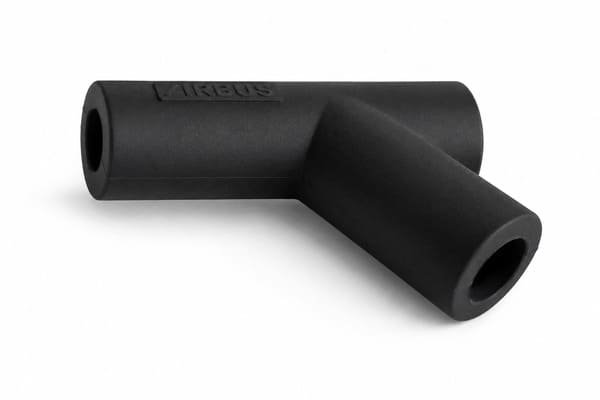
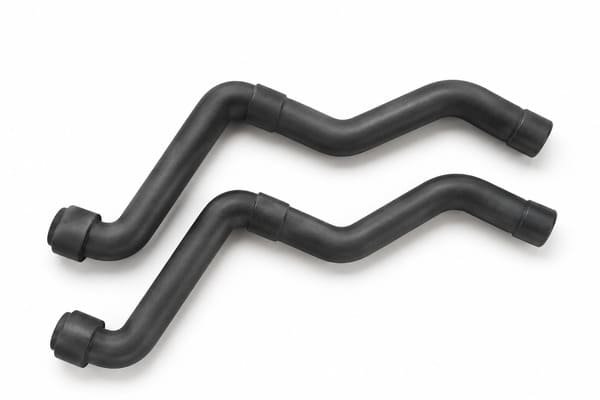
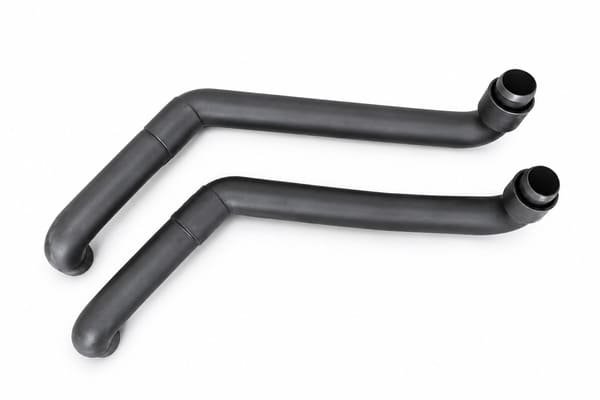
Custom molded condensate siphon hose made from black EPDM at 60 Shore A, with a 3 ± 0.1 mm wall thickness and three-dimensional bent routing profile. Connection diameters, bend geometry, branch position, marking, tolerances, and packaging can be evaluated for compatible condensate-management assemblies.
This custom molded condensate siphon hose is a black EPDM 60 Shore A component with a 3 ± 0.1 mm general wall thickness. Its three-dimensional bent profile includes a 275.5 ± 3 mm projected height and integrated connection ends for routing condensate within a compatible siphon assembly.
Custom Molded Condensate Siphon Hose, EPDM 60 ShA
This is a custom molded rubber siphon hose, designated “Durite Siphon Effinox2,” engineered to route condensate away from a gas-fired boiler’s siphon trap through a complex multi-bend flow path. Molded from EPDM rubber at 60 Shore A hardness, the part is designed to meet EN 15502-2-1 and EN 14241-1 boiler component standards, specifically addressing condensate acidity resistance required in flue gas drainage applications.
Product Overview
| Parameter | Specification |
|---|---|
| Product Name | Durite Siphon Effinox2 |
| Material | EPDM, 60 Shore A |
| Wall Thickness | 3mm plus or minus 0.1mm |
| Estimated Volume | 85 cubic centimeters |
| Estimated Mass | 106 grams, plus or minus 5 percent |
| Color | Black, homogeneous, no process marks |
| Temperature Rating | 80 degrees Celsius continuous, 95 degrees Celsius peak |
| Condensate Resistance | Per EN 15502-2-1 Section 8.102, resistance greater than 3 pH |
| Compliance Standards | EN 15502-2-1 Paragraph 8.103, EN 14241-1 Paragraphs 5.4, 6.4, and 6.5 |
| Erp ID | 700 U0721424 0 |
Why EPDM for Condensate Siphon Hoses
EPDM rubber is the standard material choice for boiler condensate siphon hoses because flue gas condensate is highly acidic in nature, and EPDM offers strong resistance to acids, ozone, weathering, and hot water exposure that would degrade many other elastomers over time. This part’s specification explicitly calls out condensate resistance testing per EN 15502-2-1 Section 8.102, requiring the material to maintain performance against condensate with a pH greater than 3, directly reflecting the corrosive nature of the fluid this hose carries. EPDM’s typical continuous service range extends from approximately negative 40 degrees Celsius up to around 120 degrees Celsius, comfortably covering this part’s specified 80 degree Celsius continuous and 95 degree Celsius peak temperature rating.
Geometric and Dimensional Overview
The hose follows a complex three-dimensional routing path with multiple bend sections, connection diameters, and formed transitions, documented across Section A-A, Section B-B, and Detail A views.
| Feature | Value |
|---|---|
| Overall hose length (Section A-A) | 275.5 ±3 mm |
| Upper leg length (Section A-A) | 205.3 mm |
| Lower offset dimension | 107.75 ±3 mm |
| Diagonal reference length | 122.4 mm |
| Secondary diagonal reference | 91.4 mm |
| Bend angle (Section A-A, upper) | 125° |
| Bend angle (Section A-A, lower) | 150° |
| Bend angle (Section A-A, mid) | 95° |
| Bend radius (large) | R18 |
| Overall hose length (Section B-B) | 100.3 ±3 mm |
| Upper connector height | 84 mm |
| Total connector reference height | 104 mm |
| Bend angle (Section B-B) | 95° |
| Bend radius (Section B-B) | R18, R1 |
| Connection point spacing | 20mm, 22mm |
| Small end outer diameter | Φ18.8 (0/-0.6 tolerance) |
| Mid-body outer diameter | Φ24.8 |
| Wall reference thickness | 1.75mm |
| Detail A large end diameter | Φ31 |
| Detail A stepped diameters | Φ19.7, Φ22.2, Φ21.2 |
| Detail A critical bore diameter | Φ25 (0/-0.6 tolerance) |
| Third section overall length | 103.5 mm |
| Third section step height | 32.67 mm |
| Third section bend angle | 95°, 150° |
| Third section large end diameter | Φ27.9 |
Technical Requirements Summary
General Tolerances and Process Standards
- Unspecified tolerances follow NFT58000 category 4, normal class.
- Form tolerance per 3D CAD, callout 1.
- General wall thickness held at 3mm plus or minus 0.1mm.
- Part must comply with EN 15502-2-1 Paragraph 8.103 and EN 14241-1 Paragraphs 5.4, 6.4, and 6.5.
Material Requirements
- Estimated volume of 85 cubic centimeters per part.
- Estimated mass of 106 grams, plus or minus 5 percent.
- Temperature rating of 80 degrees Celsius continuous with a 95 degree Celsius peak allowance.
- Condensate resistance verified per EN 15502-2-1 Section 8.102, requiring resistance to condensate above pH 3.
Process Geometry Controls
- Maximum burrs and parting line split limited to 0.3mm.
- Injection point protrusion limited to a maximum of 0.1mm and maximum depth of 1mm.
- No sharp edges permitted on the finished part.
- No detached or detachable particles allowed.
Marking Requirements
- Marking location must be proposed by the supplier.
- Markings must include product reference plus a removable index, date of manufacture, and material designation.
Aspect and Color
- Material color specified as black.
- Homogeneous color required with no visible process marks.
Supplier Drawing Package Requirements
- Supplier must provide a complete drawing package covering raw material definition, detailed material composition, raw material limit conditions (temperature, UV exposure), full dimensions and tolerance details, storage specifications, flammability commitment matched to conditions of use, rubber assembly process and interface definition, electrical specification (where applicable), durability commitment, cleanliness specification, and protection packaging proposal.
Common Applications
- Condensate drainage siphon connections in gas-fired condensing boilers, routing acidic flue gas condensate safely away from the heat exchanger.
- Complex multi-bend rubber routing applications where rigid piping cannot accommodate the required directional changes within tight equipment enclosures.
- HVAC and heating appliance components requiring certified compliance with EN 15502-2-1 and EN 14241-1 boiler safety and performance standards.
- General acidic condensate handling applications benefiting from EPDM’s proven resistance to low-pH fluids and elevated operating temperatures.
Frequently Asked Questions
What are the main dimensions of this condensate siphon hose?
The general wall thickness is 3 ± 0.1 mm, the principal projected height is 275.5 ± 3 mm, and one projected span is 100.3 ± 3 mm. The component also includes multiple specified lengths, diameters, angles, and bend radii. All mating-interface dimensions should be confirmed before tooling or production.
What material and hardness are specified?
The confirmed material is black EPDM rubber with a hardness of 60 Shore A. The exact compound formulation and supporting material documentation are available upon request. Compound approval should consider the specified temperature, condensate chemistry, pH, exposure duration, assembly stress, and applicable equipment requirements.
What temperature and condensate conditions are specified?
The specified temperature condition is 80°C with a 95°C peak. Condensate resistance is referenced to EN 15502-2-1 §8.102 for the stated condition above pH 3. Suitability outside these conditions must be evaluated using the actual condensate composition, exposure duration, temperature cycle, and finished hose.
Can the hose geometry be customized for another siphon location?
Yes. Projected lengths, heights, bend angles, bend radii, branch position, connection diameters, flange geometry, and wall thickness can be evaluated for customization. Complete installation-space data and both mating interfaces are required because a change in siphon position may affect fit, internal routing, tooling, and assembly performance.
How are surface quality and dimensional consistency controlled?
The specification limits parting-line burrs and splits to 0.3 mm and injection-point protrusion to 0.1 mm, with a maximum depth of 1 mm. It also requires no sharp edges or detachable particles. Dimensional controls and form comparison should be agreed upon using the approved specifications and 3D geometry.
Are samples, tooling, MOQ, and lead time available?
These details are available upon request. They depend on the final three-dimensional geometry, EPDM compound, interface dimensions, tolerances, tooling structure, validation requirements, inspection plan, marking, packaging, order quantity, and estimated annual volume. Prototype samples should be tested in the actual siphon assembly before production approval.
Request Product Evaluation
Provide the complete hose geometry, mating-interface dimensions, installation layout, EPDM requirements, condensate conditions, temperature, inspection criteria, quantity, and estimated annual volume. A 2D drawing, 3D model, or physical sample will support evaluation of mold feasibility, connection fit, samples, tooling, MOQ, lead time, marking, and protective packaging.