Product Overview
Reliable custom rubber parts for industrial applications
Quick Answer
Rubber impeller with brass insert is a flexible vane pump component for water pumps, marine pumps, coolant pumps, circulation pumps and industrial fluid handling systems. Outer diameter, height, blade profile, hub design, brass insert structure, thread size, rubber compound, Shore A hardness, tolerance and packaging can be customized according to drawings or samples.
A rubber impeller with brass insert is a flexible vane pump component used in liquid transfer, cooling circulation, marine pumps and industrial fluid handling systems. The molded rubber body supports suction and flow, while the brass insert provides a stronger shaft connection. Dimensions, blade profile, insert structure, rubber compound, hardness and tolerance can be customized according to drawings or samples.
Product Overview
The Rubber Impeller with Brass Insert is a flexible multi-vane pump component molded around a precision brass core, providing a secure, corrosion-resistant connection between the rubber body and the pump shaft. Brass inserts are widely used across marine and industrial flexible impeller pumps because they offer superior corrosion resistance compared to steel, along with smoother, more precise machining for a tighter, more reliable shaft fit. This impeller family is produced across a full range of sizes, blade counts, and hub drive types — including spline drive, keyway, and double flat drive configurations — to match engine cooling pumps, bilge pumps, and general industrial fluid transfer pumps.
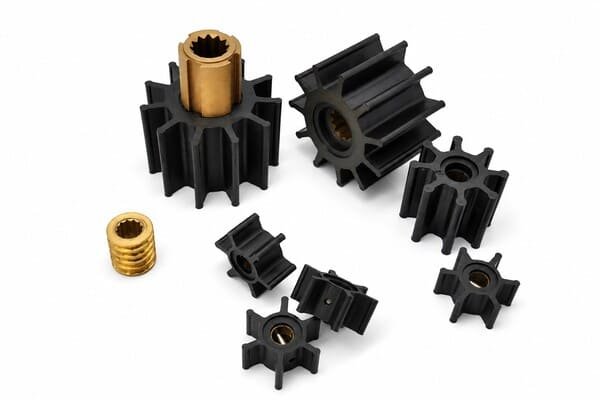
The attached product image illustrates the range Julong Rubber manufactures: a large 12-vane impeller with an extended brass spline hub, a mid-size 8-vane impeller, a compact 6-vane impeller, several small 4–6 vane impellers with recessed brass inserts, and a standalone brass insert component shown separately — demonstrating the full scope of insert molding capability across impeller sizes.
Key Technical Specifications
| Parameter | Value / Range |
|---|---|
| Material Options | Neoprene (CR), NBR, NR, EPDM, Silicone, HNBR, SBR |
| Insert Material | Brass (corrosion-resistant, precision machined) |
| Insert Function | Secure shaft mounting; spline, keyway, or double-flat drive engagement |
| Blade Configuration | 4 to 12 vanes depending on model size |
| Diameter Range | Approx. 30 mm to 120+ mm (custom sizes available) |
| Hardness | 30–95 Shore A |
| Temperature Range | -40°C to +300°C depending on compound |
| Hub Insert Types | Spline drive, keyway/key drive, double flat drive, single flat drive |
| Media Compatibility | Seawater, freshwater, bilge water, oily/contaminated water, general industrial fluids |
| Certification | ISO 9001 / IATF 16949 capable |
| MOQ | Prototype samples available; low MOQ for standard parts |
What Is a Brass Insert Impeller?
A brass insert impeller is a flexible rubber impeller molded around a precision brass core that provides the mechanical interface between the impeller and the pump shaft. During manufacturing, the brass insert is placed into the mold before the rubber compound is injected or compressed around it, forming a permanent bonded connection through the insert molding process. This method produces a single integrated component with far greater structural integrity and shaft-fit precision than a purely rubber hub, especially under sustained torque and vibration in marine and industrial pump service.
Why Brass Instead of Steel Inserts
Brass is specifically selected over plain steel or stainless steel inserts for several engineering reasons:
- Superior marine corrosion resistance — brass does not rust and resists galvanic corrosion in seawater and brackish water environments better than plain steel
- Smoother, more precise machining — brass is more machinable than stainless steel, resulting in cleaner thread and spline profiles and a more secure, consistent fit with the rubber body
- Enhanced structural integrity — the strength-to-corrosion-resistance ratio of brass helps the impeller maintain hub integrity through repeated thermal cycling and wet/dry service
- Reliable bonding to rubber — brass inserts bond securely to the rubber matrix during vulcanization or insert molding, preventing insert pull-out under torque
- Compatibility across drive types — brass inserts can be precision-machined into spline, keyway, or flat-drive geometries, unlike some plastic insert alternatives that are limited in complexity
Hub Drive Types Available
This impeller family is produced across multiple hub drive configurations to match different pump shaft designs:
- Spline Drive — multi-tooth internal spline for high-torque engine cooling pump applications; common in 10-, 12-, and 7-spline configurations
- Keyway / Key Drive — a single keyway slot engaging a shaft key, used widely in heavy-duty diesel engine auxiliary pumps
- Double Flat Drive — two opposing flat faces on the bore for simple, robust torque transfer in general-purpose pumps
- Single Flat Drive — a single flat face drive used in smaller, lower-torque impeller applications
Material Selection Guide
| Material | Key Properties | Best Use |
|---|---|---|
| Neoprene (CR) | Excellent seawater and general marine resistance | Marine engine cooling, general-purpose pumps |
| NBR (Nitrile) | Excellent oil resistance | Oily bilge water, industrial oil-contaminated fluids |
| NR (Natural Rubber) | Excellent elasticity, wear resistance | Clean water, general-purpose pumping |
| EPDM | Excellent weathering, ozone, hot water resistance | Freshwater and outdoor pump systems |
| Silicone | High-temperature resistance | Specialty high-heat applications |
| Food-Grade Compounds | FDA/3A sanitary compliant | Food and beverage transfer pumps |
Product Advantages
- Secure shaft mounting — brass insert provides a positive mechanical connection, reducing slippage risk versus friction-fit rubber-only hubs
- Corrosion resistance — withstands prolonged seawater and marine environment exposure without insert degradation
- Precision fit — machined brass geometry ensures accurate, repeatable shaft engagement across production batches
- Durability under torque — resists insert pull-out and wear under sustained rotational load
- Wide size range — available from compact 30 mm impellers to large 120mm+ industrial pump impellers
- Multiple drive compatibility — spline, keyway, and flat drive options cover the majority of OEM pump shaft designs
Applications
Rubber impellers with brass inserts are used across a wide range of marine and industrial pump applications:
- Marine diesel and gasoline engine raw-water cooling pumps
- Bilge pumps and heavily contaminated water transfer
- Deck washdown and general-purpose marine pumps
- Industrial circulation and transfer pumps
- Slurry and mineral processing pumps
- Agricultural and irrigation equipment pumps
- Food and beverage hygienic transfer pumps (food-grade compound variants)
Manufacturing Process
Julong Rubber produces brass insert impellers using a precision insert molding process:
- Insert preparation — brass cores are precision machined to the required spline, keyway, or flat-drive geometry, then cleaned and surface-treated to promote rubber bonding
- Insert placement — the prepared brass insert is positioned within the mold cavity
- Rubber injection/compression — the selected rubber compound is injected or compression molded around the insert, forming a permanent bonded connection
- Curing and inspection — the molded impeller is cured, then inspected for dimensional accuracy, insert bond integrity, and blade geometry consistency
- Finishing — flash removal and final quality inspection before packaging
Customization Capabilities
Julong Rubber can customize this impeller family with:
- Blade count and blade geometry (4 to 12+ vanes)
- Outer diameter, width, and hub bore dimensions
- Insert type — spline, keyway, double flat, or single flat drive
- Insert material — brass standard; stainless steel or aluminum available on request
- Rubber compound — Neoprene, NBR, NR, EPDM, Silicone, or food-grade formulations
- Hardness — tuned for wear resistance vs. flexibility balance
- Color and branding — standard black; custom colors available
- OEM drawing or physical sample reverse engineering
Why Source from Julong Rubber?
- ISO 9001 / IATF 16949 capable manufacturing
- Precision brass insert molding expertise — spline, keyway, and flat drive configurations
- OEM drawing or physical sample reverse engineering
- Full elastomer range — Neoprene, NBR, NR, EPDM, Silicone, food-grade compounds
- Low MOQ for development and aftermarket programs
- Marine and industrial pump application experience
- English technical support and fast quotation response
FAQ
What is a rubber impeller with brass insert used for?
A rubber impeller with brass insert is used in pump systems where flexible rubber vanes help move compatible liquids and the center connection requires a durable metal interface. The brass insert can support threaded, bored, splined, keyed or custom shaft connection designs.
Can the brass insert structure be customized?
Yes. The brass insert can be customized according to the shaft design, thread size, thread depth, bore diameter, spline, keyway or other connection requirement. Buyers should provide a drawing, pump shaft specification or physical sample for accurate insert design review.
How should buyers select the rubber material?
Rubber material selection depends on the working liquid, temperature, rotation speed, oil exposure, chemical contact and dry-running risk. EPDM, NBR, CR, FKM or other compounds can be reviewed according to the application conditions and media compatibility requirements.
Why is rubber-to-brass bonding important?
The bond between the rubber body and brass insert affects torque transfer, shaft stability and long-term pump operation. Bonding design should consider insert geometry, surface preparation, operating load, shaft alignment, rotation speed and liquid exposure inside the pump.
Can the impeller be produced from an old sample?
Yes. A physical sample can be used for reverse engineering when the original drawing is unavailable. The sample should be checked for wear, deformation and blade damage. Critical dimensions, shaft connection and pump operating conditions should still be confirmed before tooling.
Are samples available before bulk production?
Samples are available upon request. Sample preparation depends on confirmed dimensions, brass insert structure, rubber compound, Shore A hardness, tooling status and inspection requirements. Please provide a drawing, 3D model or physical sample for technical review.
Request a Custom Quote
Send your rubber impeller with brass insert drawing, pump assembly drawing, 3D model or physical sample for review. Please include dimensions, blade profile, insert structure, thread or shaft detail, rubber material, hardness, working liquid, temperature, rotation speed, quantity and packaging requirements.