Product Overview
Reliable custom rubber parts for industrial applications
Quick Answer
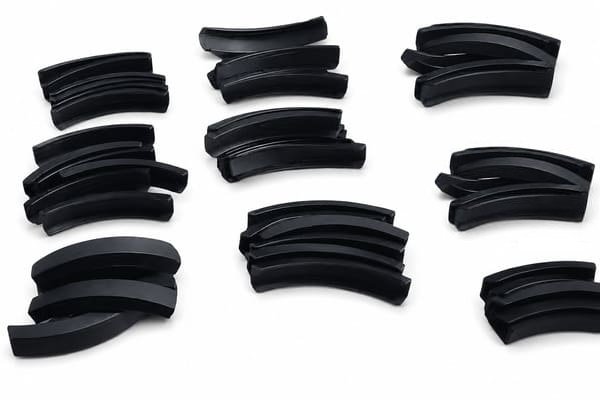
Quadruped Robot Rubber Joint Clamps are black curved SBR buffer pads for robot dog joints, quadruped robot leg assemblies and articulated robotic interfaces. Available options include SBR Clamp Buffer Pad 1-1.3 and SBR Clamp Buffer Pad 2-0.8, with provided radius-based dimensions for compatible joint buffering and surface protection.
Quadruped Robot Rubber Joint Clamps are curved elastomer buffer pads used around robotic joint interfaces for cushioning, protection, positioning support and vibration reduction. The set includes two TPU clamp buffer pad options with compact curved profiles. Provided sizes include approximately 57.82 × 39.80 × 14.41 mm and 54.46 × 46.39 × 14.70 mm.
Quadruped Robot Rubber Joint Clamps — Curved SBR Buffer Pads for Leg Joint Protection
Quadruped Robot Rubber Joint Clamps are curved, arc-shaped buffer components molded from SBR rubber at 70 ± 5 Shore A hardness, designed to wrap around and protect the joint housings, motor connections, and cable routing on four-legged robotic leg assemblies. Available in two distinct sizes with precisely defined outer envelope dimensions and radius profiles, these clamps provide firm cushioning against impact while helping retain internal wiring in place during repeated joint articulation.
Key Specifications
| Parameter | Buffer Pad 1 | Buffer Pad 2 |
|---|---|---|
| Product Name | SBR Clamp Buffer Pad 1-1.3 | SBR Clamp Buffer Pad 2-0.8 |
| Overall Envelope Dimensions | Approx. 57.82 x 39.80 x 14.41 mm | Approx. 54.46 x 46.39 x 14.70 mm |
| Inner Body Radius | R56.8 mm | R51.3 mm |
| Outer Body Radius | R63.8 mm | R55.3 mm |
| Radial Width | Approx. 7.0 mm | Approx. 4.0 mm |
| Material | SBR (Styrene Butadiene Rubber) | SBR (Styrene Butadiene Rubber) |
| Hardness | 70 ± 5 Shore A | 70 ± 5 Shore A |
| Color | Black | Black |
What Is a Quadruped Robot Joint Clamp?
A quadruped robot joint clamp is a curved buffer component that wraps around a robotic leg’s joint housing or cable routing point, cushioning the connection against impact while helping secure wiring in place through repeated flexing cycles. Both reference sizes in this clamp series are molded from SBR rubber at 70 ± 5 Shore A hardness and built around a curved arc geometry defined by an inner and outer body radius, with Buffer Pad 1 spanning a radial width of approximately 7.0mm between its R56.8mm inner radius and R63.8mm outer radius, and Buffer Pad 2 offering a narrower 4.0mm radial width between its R51.3mm inner radius and R55.3mm outer radius. This dual-size approach allows different clamp profiles to be matched to varying joint diameters and cable bundle thicknesses across a robot’s leg assembly.
Dimensional Profile
| Feature | Buffer Pad 1-1.3 | Buffer Pad 2-0.8 |
|---|---|---|
| Overall length | 57.82 mm | 54.46 mm |
| Overall width | 39.80 mm | 46.39 mm |
| Overall height | 14.41 mm | 14.70 mm |
| Inner body radius | R56.8 mm | R51.3 mm |
| Outer body radius | R63.8 mm | R55.3 mm |
| Radial width | Approx. 7.0 mm | Approx. 4.0 mm |
| Hardness | 70 ± 5 Shore A | 70 ± 5 Shore A |
The curved cross-section defined by the inner and outer radii on each clamp allows the part to seat naturally around a cylindrical joint housing or cable bundle, distributing clamping pressure evenly along the contact arc rather than concentrating stress at a single point.
Material Properties: SBR Rubber (70 ± 5 Shore A)
Both buffer pads are molded from SBR (styrene butadiene rubber), a material chosen for joint clamp applications requiring a firm, load-supportive grip combined with strong wear resistance.
- Firm, Load-Supportive Hardness: At 70 ± 5 Shore A, this compound provides a firmer clamping grip than softer rubber alternatives, maintaining consistent clamping force around the joint housing under repeated articulation.
- Strong Abrasion Resistance: SBR is well regarded for its resistance to surface wear from friction with cable bundles and adjacent leg components.
- Impact Durability: The compound’s density and hardness help it withstand repeated mechanical stress without rapid deformation or surface breakdown.
- Dimensional Precision: Tight control over inner/outer radius and radial width ensures a consistent, secure fit around the target joint diameter across production batches.
- Consistent Black Finish: Both sizes are manufactured in black for uniform appearance and simplified visual wear inspection.
Two-Size Buffer System
| Feature | Benefit |
|---|---|
| Buffer Pad 1 (wider 7.0mm radial width) | Suited to larger joint housings or thicker cable bundles requiring more cushioning depth |
| Buffer Pad 2 (narrower 4.0mm radial width) | Suited to smaller joint diameters or tighter clearance zones within the leg assembly |
| Matched radius pairs (inner/outer) | Ensures a snug, curve-matched fit against the target joint surface |
| Shared SBR material, hardness, and color | Consistent clamping performance and appearance across both clamp sizes in a full leg set |
Key Features
- Two precisely dimensioned buffer sizes to match different joint diameters and cable bundle thicknesses.
- Curved arc geometry with defined inner and outer radii for a secure, evenly distributed clamping fit.
- Firm 70 ± 5 Shore A SBR hardness delivers strong clamping grip and long-term wear resistance.
- Consistent black finish across both sizes for uniform appearance in a complete leg assembly.
- Compact overall envelope (under 60mm in the longest dimension) suited to space-constrained joint locations.
Common Applications
- Joint housing protection on quadruped robot leg assemblies.
- Cable and wiring retention at articulating joint connections.
- Impact cushioning at motor and actuator connection points on robotic limbs.
- Field-deployed robotic platforms requiring durable, replaceable joint protection.
- General robotic joint sealing and cable management applications beyond quadruped platforms.
Why SBR Is Well Suited for Joint Clamps
SBR rubber offers a practical combination of firm hardness, abrasion resistance, and cost-effective durability, making it well suited for clamp components that must maintain steady clamping pressure around a curved joint surface over extended service life. The 70 ± 5 Shore A hardness selected for this clamp series provides a firmer grip than softer rubber alternatives, which is especially valuable in robotic leg joints subjected to continuous articulation cycles, where reduced clamping force over time could allow cable movement or diminished joint protection.
Custom Manufacturing Options
- Custom inner and outer radius dimensions to match specific joint housing diameters.
- Custom radial width for different cushioning depth requirements.
- Custom overall envelope dimensions for alternate leg assembly layouts.
- Custom color for component identification.
- Custom Shore hardness grade for different clamping force or flexibility balance.
Frequently Asked Questions
Q: What sizes are available for this joint clamp?
A: Two reference sizes are available: Buffer Pad 1 at approximately 57.82 x 39.80 x 14.41 mm with a 7.0mm radial width, and Buffer Pad 2 at approximately 54.46 x 46.39 x 14.70 mm with a 4.0mm radial width.
Q: What material are these joint clamps made from?
A: Both sizes are molded from black SBR (styrene butadiene rubber) at 70 ± 5 Shore A hardness.
Q: What is the purpose of the inner and outer radius dimensions?
A: These radii define the curved arc geometry of the clamp, allowing it to seat securely around a cylindrical joint housing or cable bundle with evenly distributed clamping pressure.
Q: Which buffer size should I choose for my application?
A: Buffer Pad 1’s wider 7.0mm radial width suits larger joint housings or thicker cable bundles, while Buffer Pad 2’s narrower 4.0mm radial width suits smaller joint diameters or tighter clearance zones.
Q: Why is 70 Shore A hardness used for these clamps?
A: This firmer hardness grade maintains consistent clamping force around the joint housing over repeated articulation cycles, offering stronger grip retention than softer rubber compounds.
Q: Can these clamps be customized for different joint diameters?
A: Yes, inner/outer radius, radial width, overall envelope dimensions, hardness, and color can all be adjusted to match specific robotic leg joint designs.
Request a Custom Quote
Send the confirmed specification, 3D model, physical sample or robotic joint interface information for review. Please include product option, envelope size, inner radius, outer radius, radial width, TPU material requirement, hardness, installation position, load condition, quantity, annual demand and packaging method.