Product Overview
Reliable custom rubber parts for industrial applications
Quick Answer
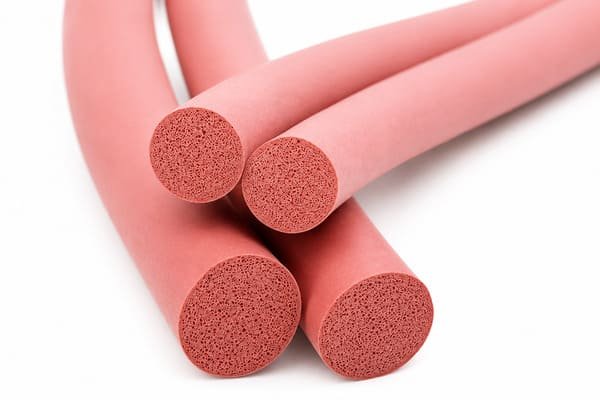
Pink silicone sponge rubber cords feature a round profile, smooth outer surface, and compressible cellular interior. They are intended for sealing, cushioning, vibration control, and gap filling. Cord diameter, hardness, density, length, tolerance, packaging, and application-specific requirements can be evaluated upon request.
Pink silicone sponge rubber cords are round, flexible profiles with a smooth outer surface and a cellular interior. They are intended for compressible sealing, cushioning, gap filling, and vibration-control applications. Cord diameter, density, hardness, cell structure, dimensional tolerance, and application-specific performance are available upon request.
Product Overview
Silicone sponge cord is produced through an extrusion process that incorporates a blowing agent into the silicone compound, creating a cellular, closed-pore internal structure that gives the material its characteristic softness and compressibility compared to solid silicone rubber cord. While natural, unpigmented silicone sponge typically appears off-white due to the blowing agent additives used during manufacturing, custom color pigmentation such as pink is commonly applied for visual identification, color-coding across different product lines, or brand-specific specification requirements. The closed-cell structure gives this cord airtight sealing performance while keeping water absorption minimal, an important property in outdoor or moisture-exposed sealing applications.
Key Material Properties
| Property | Typical Value |
|---|---|
| Material Type | Silicone (VMQ), closed-cell sponge structure |
| Temperature Range | Approximately -60 degrees Celsius to 230 degrees Celsius, with some formulations rated to 315 degrees Celsius intermittent |
| Density Range | Approximately 200 kg per cubic meter (soft) to 600 kg per cubic meter (firm) |
| Hardness | Very soft, often around Shore A 5 for sponge grades compared to Shore A 60 for solid silicone cord |
| Water Absorption | Less than 1 percent, supporting reliable sealing in moisture-prone environments |
| Elongation at Break | Approximately 145 percent for typical sponge grades |
| Compression Set | Approximately 3.8 percent under standard test conditions |
Why Silicone Sponge Outperforms Standard Rubber Cord
Silicone sponge rubber cord retains all the core benefits of solid silicone rubber, including outstanding resistance to ultraviolet light, ozone, and weathering, while its cellular structure allows it to achieve an effective seal using significantly lower compression force than solid cord of the same dimensions. This lower closure force requirement makes sponge cord particularly valuable in applications like access panels, enclosure doors, and lightweight gasketing where excessive mechanical clamping pressure is impractical or would risk damaging surrounding components. Because the material remains stable across an unusually wide temperature range, spanning from deep sub-zero conditions to well above 200 degrees Celsius, it performs reliably in both extreme cold storage environments and high-heat applications such as oven and appliance seals.
Performance Across Temperature Extremes
Silicone sponge cord maintains its flexibility and sealing integrity at low temperatures where many organic rubber compounds would become brittle and lose their compressive recovery properties. At the high end of its range, the material resists embrittlement significantly better than many alternative sponge materials, with some manufacturers rating continuous exposure up to around 200 degrees Celsius and intermittent exposure considerably higher. This dual-extreme stability is a key reason silicone sponge cord is frequently specified for harsh environment gasketing, high-temperature sealing, and equipment that cycles between very different thermal conditions during normal operation.
Chemical Resistance and Limitations
While silicone sponge cord resists weathering, aging, and general environmental exposure effectively, it is not well suited for contact with oils, solvents, dilute alkalis, or concentrated acids, and it should be avoided in applications involving significant abrasion. These limitations are important to consider during material selection, since a chemically inappropriate application can lead to premature swelling, softening, or degradation of the silicone material regardless of its otherwise strong temperature and weathering performance.
Common Applications
- Color-coded sealing components where a pink or other custom color aids in visual identification across different product lines or assembly stations.
- Oven and appliance door seals requiring reliable performance across repeated high-temperature heating cycles.
- Enclosure and access panel gasketing in outdoor communications and electronics equipment, benefiting from FDA-compliant, weather-resistant sealing.
- Food processing machinery seals, where compliance with food equipment material standards supports safe use in production environments.
- General industrial harsh environment gasketing, including packaging equipment and high-voltage insulation applications.
Frequently Asked Questions
Can the silicone sponge rubber cord diameter be customized?
Custom cord diameters can be evaluated upon request. Please provide the required diameter, dimensional tolerance, cut length or coil length, and expected order quantity. If the cord will be installed in a groove, include the groove width, groove depth, and assembled gap so the required compression can be reviewed.
What hardness is available for pink silicone sponge cord?
The hardness has not been specified and is available upon request. Selection should consider the required compression force, sealing pressure, recovery, installation method, and joint movement. Please provide the target hardness or a physical sample when an existing cord must be matched.
Is the cell structure open-cell or closed-cell?
The exact cell structure has not been confirmed. If air, water, dust, or fluid sealing is required, specify the performance requirement and test method during the quotation stage. Cell structure, density, surface condition, joint design, and compression level can materially affect sealing performance.
Can the cord be supplied in cut lengths or continuous coils?
Cut lengths and continuous packaging formats can be evaluated upon request. Please specify the required length, quantity per package, allowable length tolerance, coil size, and whether the cut ends require additional processing. Final availability depends on the confirmed cord diameter and production specification.
Can prototype samples be produced before mass production?
Prototype sample availability is subject to the required diameter, material specification, tooling condition, and quantity. Provide a drawing, physical sample, or complete dimensional requirements for evaluation. Sample approval criteria should include dimensions, appearance, compression behavior, and any required application-specific testing.
Does this silicone sponge cord meet food-contact or other compliance requirements?
No compliance status has been confirmed for this product. If food-contact, flame resistance, electrical, environmental, or another regulated requirement applies, identify the exact standard before quotation. The material grade and supporting documentation must then be reviewed and confirmed separately.
Request Product Evaluation
Provide the required cord diameter, length, hardness, density, tolerance, application conditions, installation dimensions, and estimated quantity for evaluation. A 2D drawing, physical sample, or groove detail will help confirm manufacturing feasibility. Please also identify any compression, sealing, inspection, packaging, documentation, or compliance requirements before quotation.