Product Overview
Reliable custom rubber parts for industrial applications
Quick Answer
These NBR rubber sleeves are developed for compatible axial flow valves. The small sleeve measures approximately 240 × 150 mm, and the large sleeve measures approximately 285 × 175 mm. Exact dimension definitions, wall profile, hardness, tolerances, media compatibility, and valve fitment must be confirmed before production.
These NBR rubber sleeves are flexible flow-control components for axial flow valves. Two approximate overall sizes are available: 240 × 150 mm for the small sleeve and 285 × 175 mm for the large sleeve. Exact dimensional definitions, tolerances, hardness, pressure range, and media compatibility must be confirmed according to the valve specification.
Rubber Sleeves for Axial Flow Valves — Precision Molded NBR Replacement Sleeves
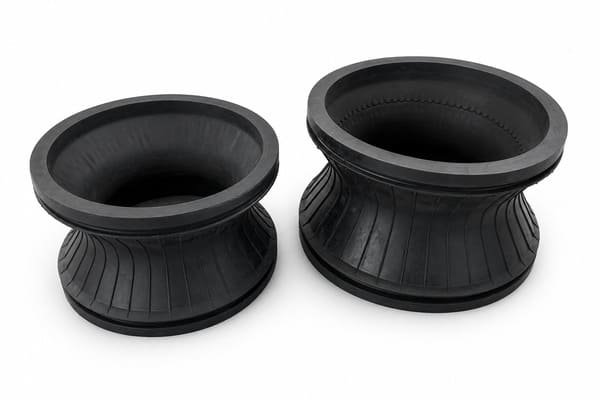
Rubber sleeves for axial flow valves are flexible molded elastomer components that serve as the core flow-control and sealing element inside AFV-type pressure regulators, flexing under the balance of upstream line pressure and pilot-controlled backpressure to throttle or shut off gas flow without any mechanical linkage. These sleeves feature a distinctive ribbed, hourglass-shaped profile with a flared collar at each end, allowing them to seat correctly against the valve’s internal control ring while flexing smoothly through their working stroke. Rubber sleeves are supplied in multiple sizes to match different AFV valve models, with NBR being a commonly specified compound for general gas distribution service.
Key Specifications
| Parameter | Small Sleeve | Large Sleeve |
|---|---|---|
| Material | NBR (Nitrile Butadiene Rubber) | NBR (Nitrile Butadiene Rubber) |
| Approximate Size | 240mm x 150mm | 285mm x 175mm |
| Profile | Ribbed hourglass shape with flared collar ends | Ribbed hourglass shape with flared collar ends |
| Color | Black | Black |
| Common Marking | Molded code (e.g. H-7 or equivalent) | Molded code (e.g. H-7 or equivalent) |
| Compatible Brands | ELSTER, American Meter, AFV-style regulators | ELSTER, American Meter, AFV-style regulators |
| Manufacturing Process | Compression molding | Compression molding |
| Common Applications | City gate stations, district regulator stations, industrial pressure regulation | Larger-flow city gate and district regulator stations |
What Is a Rubber Sleeve for an Axial Flow Valve?
An axial flow valve (AFV) is a non-mechanical, instrument-controlled regulator that balances positive pressure and backpressure acting on a flexible rubber sleeve to control gas flow, rather than relying on a conventional disc, ball, or plug mechanism. This design, originally patented by an American instrument company in the 1970s, is valued for its simple structure, compact size, light weight, high accuracy, large flow capacity, low noise, and ease of installation and maintenance, making it widely used in city gate stations, high/medium pressure regulator stations, district regulator stations, industrial pressure control, full-flow pipeline venting, and flow-limiting emergency shutoff applications. The rubber sleeve is the single moving part responsible for all of this functionality, flexing continuously as the pilot instrument combination adjusts the balance between upstream pressure and the sleeve’s backpressure chamber.
Small vs. Large Sleeve Sizing
- Small sleeve (approx. 240mm x 150mm) — sized for smaller AFV valve models, typically used in lower-flow city gate or district regulator applications where a compact valve body is sufficient.
- Large sleeve (approx. 285mm x 175mm) — sized for larger AFV valve models, supporting higher flow capacity installations such as larger district regulator stations or higher-throughput industrial pressure control points.
- Both sizes share the same core ribbed hourglass profile and flared collar design, differing primarily in overall diameter and height to match their respective valve body sizes.
- Selecting the correct sleeve size is critical, since an AFV valve is designed around one specific sleeve dimension, and an incorrectly sized sleeve will not seat or seal correctly within the valve’s control ring.
Why NBR Is Used for AFV Sleeves
- General gas compatibility — NBR offers solid resistance to the hydrocarbon gases and trace condensates typically found in natural gas distribution service.
- Cost-effective general-purpose performance — NBR provides reliable flex performance and durability at a lower cost than specialty compounds like Hydrin or fluorosilicone.
- Good flexibility under repeated cycling — maintains elasticity through the continuous flexing required as the AFV valve balances pressure and adjusts flow.
- Compatibility with standard AFV valve designs — NBR is one of several accepted sleeve materials for AFV-type valves, alongside Hydrin, Buna, Viton, and fluorosilicone, each suited to different pressure, temperature, and gas composition conditions.
Alternative Sleeve Materials for Comparison
| Material | Typical Suitability |
|---|---|
| NBR | General-purpose gas distribution service, cost-effective standard option |
| Hydrin | Standard sleeve material for most AFV applications, wide temperature range |
| Buna | Substitutable alternative in applications above 0°F |
| Viton (FKM) | Enhanced chemical and temperature resistance for demanding service |
| Fluorosilicone | Specialty applications requiring both chemical and temperature resistance |
Material selection should always be confirmed against the specific gas composition, ambient temperature range, and valve pressure class for the installation, since substituting an incompatible sleeve material can significantly shorten service life.
Sleeve Profile and Design Features
- Ribbed hourglass body — the vertical ribbing along the sleeve’s tapered midsection allows even, controlled flexing as pressure differential changes, distributing bending stress across the ribbed surface rather than concentrating it at a single point.
- Flared collar ends — the wider flanged rim at each end of the sleeve seats against the valve body’s internal seal ring, forming a leak-tight boundary between the gas flow path and the control chamber.
- Molded identification markings — sleeves are typically molded with a size or material code (such as H-7) directly into the rubber surface for traceability and correct part identification during maintenance.
- Symmetrical dual-cone shape — the mirrored conical sections on either side of the center ribbed band allow the sleeve to function correctly regardless of flow direction orientation within certain valve designs.
Manufacturing Process
Rubber sleeves for axial flow valves are produced using compression molding, where NBR compound is cured under heat and pressure within a precision-machined mold cavity shaped to form the ribbed hourglass profile and flared collar ends in a single molding operation. Careful control of mold temperature, cure time, and pressure ensures uniform wall thickness across the ribbed sections, since inconsistent thickness could create weak points prone to premature cracking under the sleeve’s continuous flexing duty. Identification markings, such as size codes, are molded directly into the sleeve surface during curing to maintain permanent, legible part identification throughout the component’s service life.
Common Applications
- City gate stations regulating incoming natural gas pipeline pressure.
- High and medium pressure regulator stations in gas distribution networks.
- District regulator stations serving residential and commercial gas distribution zones.
- Industrial pressure regulation for large gas-consuming facilities.
- Full-flow pipeline venting and pressure relief applications.
- Flow-limiting and emergency shutoff functions within AFV valve assemblies.
Custom Manufacturing Options
- Prototype and low-volume sampling available prior to full production tooling commitment.
- Custom sleeve sizing to match specific AFV valve models beyond the standard small (240mm x 150mm) and large (285mm x 175mm) sizes.
- Alternative material options (Hydrin, Buna, Viton, fluorosilicone) for applications requiring different chemical or temperature resistance than NBR provides.
- Custom hardness selection to match original valve manufacturer specifications.
- Custom molded identification marking to match existing part numbering or size codes.
- Reverse-engineering service to reproduce sleeves from a sample part or valve model number.
FAQ
What sizes are available?
Two approximate overall sizes are provided: 240 × 150 mm for the small sleeve and 285 × 175 mm for the large sleeve. The exact meaning and orientation of these measurements must be confirmed. Wall thickness and other critical dimensions are available upon request.
Are both axial flow valve sleeves made from NBR?
Yes. The small and large sleeve versions are specified as NBR. The exact compound grade and Shore A hardness are available upon request. Final compatibility depends on the process media, additives, temperature, pressure, cycling frequency, and environmental conditions.
Can the sleeve dimensions be customized?
Yes. Outer diameter, inner diameter, length, wall thickness, internal profile, end geometry, grooves, and tolerances can be customized according to the valve structure. Complete technical information or an approved physical sample is required before tooling and production.
Can a used valve sleeve be supplied as a sample?
A used sample can support structural evaluation, but swelling, wear, hardening, cracking, and permanent deformation must be considered. Valve identification and operating conditions should accompany the sample. An unused approved sleeve or confirmed technical specification is preferred.
Are prototype samples available?
Sample availability depends on the confirmed dimensions, NBR compound, tooling requirements, and requested quantity. Initial samples can be arranged after technical review. Installation fit, deformation, sealing, dimensions, hardness, and functional acceptance criteria should be defined before approval.
How are tooling, MOQ, and lead time confirmed?
Tooling, MOQ, and lead time depend on the selected sleeve size, confirmed geometry, NBR compound, inspection requirements, sample approval process, and order quantity. These details are confirmed after reviewing the complete specification and estimated annual demand.
Request a Custom Quote
Send the valve model, size reference, 2D drawing, 3D model, or physical sample for technical review. Confirm whether you require the approximately 240 × 150 mm small sleeve or 285 × 175 mm large sleeve. Include media, temperature, pressure conditions, quantity, and estimated annual volume.