Product Overview
Reliable custom rubber parts for industrial applications
Quick Answer
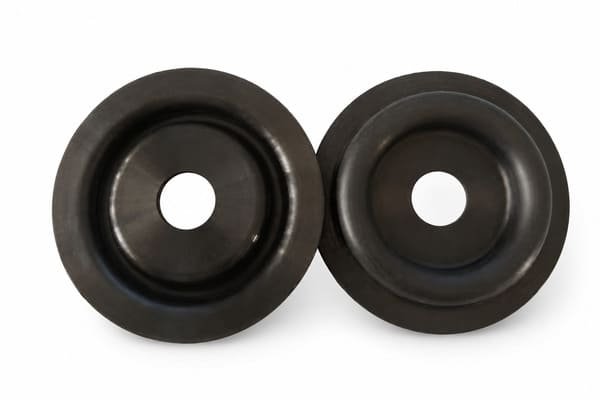
Custom black marine main engine positioner rubber diaphragms with central openings, recessed centers, annular convolutions, and flat outer flanges. Dimensions, rubber material, hardness, reinforcement, tolerances, tooling, samples, testing requirements, and packaging are available upon request.
Marine main engine positioner rubber diaphragms are black circular flexible components with a central opening, recessed center, annular convolution, and flat outer flange. They are designed for installation within compatible marine main engine positioner assemblies. Exact dimensions, material, hardness, pressure rating, reinforcement, and equipment compatibility are available upon request.
Product Overview
These marine main engine positioner rubber diaphragms have a concentric circular structure with a central opening, formed center, flexible annular convolution, and perimeter flange. The outer flange provides a defined clamping area between compatible housing components. The convolution forms the active section that can flex in response to pressure changes or mechanical displacement within the positioner. The central opening accommodates the corresponding connection or internal positioning feature. The confirmed color is black. Exact outside diameter, opening diameter, formed height, thickness, rubber polymer, Shore A hardness, reinforcement construction, manufacturing process, operating pressure, tolerances, and installation requirements have not been confirmed. Custom production can be evaluated using complete technical specifications, mating-component data, or a physical sample.
Key Features
- Fabric-reinforced elastomer construction designed to withstand the immense physical force required to move heavy marine engine linkages.
- Molded from specialized rubber compounds formulated to survive high ambient engine room temperatures and continuous structural vibration.
- Strong chemical resistance against marine-specific contaminants, including saline moisture, heavy fuel oil vapors, and compressor lubricating oils.
- Frictionless flexing action that eliminates mechanical hysteresis, ensuring the engine responds immediately to throttle adjustments.
- High burst strength to prevent blowout under sudden pneumatic pressure spikes during engine maneuvering or emergency crash-astern sequences.
Expertise: Pneumatic Control in Marine Propulsion
The main engine of a commercial vessel relies heavily on pneumatic control air to adjust its operating parameters safely. The positioner diaphragm is the core component that bridges the gap between the ship’s automated control logic and the physical engine. As the control system demands more or less power to maintain RPMs in heavy seas, the air pressure on the diaphragm constantly fluctuates. The diaphragm must execute these continuous, micro-adjustments with zero delay. Even a slight stiffness or lag in the diaphragm’s movement can cause the engine’s fuel rack to overshoot its target, leading to unstable engine speeds and inefficient fuel consumption.
Authoritativeness: Material Engineering for Engine Rooms
Marine engine rooms present a hostile operating environment characterized by extreme heat, continuous low-frequency vibration, and the constant presence of corrosive vapors. Standard industrial rubber diaphragms degrade rapidly under these conditions, hardening and cracking over time. Marine-grade positioner diaphragms are formulated from advanced synthetic rubbers, such as heavy-duty nitrile or fluoroelastomers, and are heavily reinforced with woven aramid or polyamide fabrics. This textile reinforcement ensures the diaphragm retains its precise molded shape and does not stretch or balloon when subjected to the high-pressure control air necessary to actuate massive two-stroke diesel engine components.
Trustworthiness: Reliability and Fail-Safe Operation
A rupture or failure in a main engine positioner diaphragm can lead to a sudden loss of propulsion control, creating a severe safety hazard for the vessel and crew. For this reason, these diaphragms are manufactured to strict tolerances and are expected to maintain full elasticity and airtight integrity over years of continuous oceanic service. Furthermore, they are designed to function seamlessly within fail-safe actuator systems. In the event of a total loss of ship control air, the diaphragm must yield smoothly to a heavy mechanical return spring that forces the engine linkage into a safe, predetermined position, typically cutting off fuel to prevent dangerous engine overspeed.
Common Applications
- Pneumatic positioners controlling the fuel rack linkages on large two-stroke and four-stroke marine diesel engines.
- Actuators for main engine exhaust gas bypass valves, wastegates, and turbocharger control mechanisms.
- Governor control actuators responding to dynamic load changes from the ship’s propeller in rough seas.
- Pitch control feedback mechanisms on vessels equipped with controllable pitch propellers.
Frequently Asked Questions
What does the diaphragm do inside a marine engine positioner?
The diaphragm acts as a flexible working element within a compatible positioner assembly. Pressure or mechanical input can move its active convoluted section while the outer flange remains clamped. Its exact function and response depend on the positioner design, central connection, pressure differential, movement range, and control requirements.
Which rubber material should be used for this diaphragm?
Material selection depends on the media contacting both sides, operating temperature, pressure, lubricant exposure, humidity, vibration, movement frequency, and required aging behavior. The rubber polymer cannot be confirmed from the image alone. Complete service conditions or the original material specification are required for evaluation.
Does the diaphragm contain fabric reinforcement?
Internal reinforcement cannot be confirmed from the visible surface. If fabric reinforcement is required, its material, number of layers, position, orientation, and bonding requirements must be specified. These factors influence deformation, dimensional stability, pressure response, flexibility, and manufacturing feasibility.
Can the central opening and convolution profile be customized?
Yes. The outside diameter, central opening, active diameter, convolution profile, formed height, flange width, thickness, material, hardness, reinforcement, and tolerances can be evaluated for customization. A complete specification or physical sample is required to confirm fit and manufacturing feasibility.
What pressure can the positioner diaphragm withstand?
No pressure rating has been confirmed. Pressure capability depends on the active diameter, thickness, compound, hardness, reinforcement, convolution geometry, clamping arrangement, temperature, media, stroke, and cycle conditions. Prototype parts must be validated against the agreed operating pressure and acceptance criteria.
Can an existing marine positioner diaphragm be reproduced from a sample?
A physical sample can support initial evaluation, but deformation or wear may prevent accurate dimensional recovery. Mating-component measurements, equipment specifications, and critical tolerances should also be provided whenever possible. Tooling, sample availability, MOQ, lead time, and inspection requirements are confirmed after the design review.
Request Product Evaluation
Provide the diaphragm specification or sample, positioner model, mating dimensions, rubber requirements, hardness, pressure differential, movement range, contact media, temperature, cycle conditions, quantity, and inspection criteria. These details support evaluation of the material, geometry, tooling, prototypes, manufacturing feasibility, testing requirements, and packaging.