Product Overview
Reliable custom rubber parts for industrial applications
Quick Answer
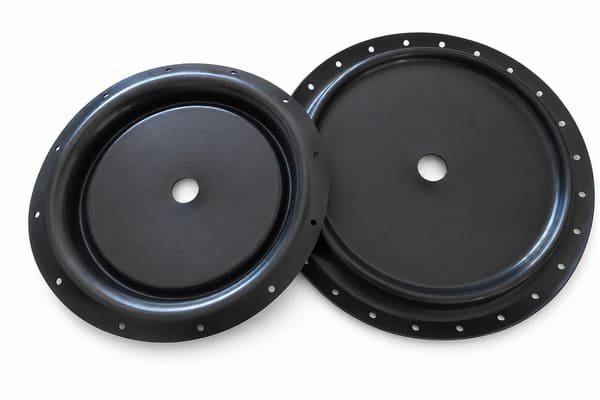
Custom large-diameter flanged rubber diaphragm with a central connection hole, multiple perimeter mounting holes, a wide flexible working area, and one deep annular convolution for axial movement. Dimensions, rubber material, hardness, tolerances, tooling, samples, and operating requirements are available upon request.
This large-diameter flanged rubber diaphragm is a circular flexible component with a wide clamping flange, multiple evenly distributed perimeter mounting holes, a central connection hole, and one deep annular convolution. The convolution provides axial movement for compatible actuator, pneumatic, pressure-control, or mechanical assemblies. Exact dimensions, rubber compound, hardness, and operating limits are available upon request.
Product Overview
This large-diameter flanged rubber diaphragm uses a concentric circular structure. A broad outer flange provides the clamping surface and contains multiple evenly distributed mounting holes. The center includes a circular connection hole within a wide, flat flexible working area. One deep annular convolution surrounds this central area and provides the geometry required for axial displacement. The pictured diaphragm is black and has a smooth molded surface appearance. In a compatible assembly, the flange is secured between mating components while the central section moves in response to pressure or mechanical input. Exact outside diameter, working diameter, hole pattern, convolution profile, thickness, material, Shore A hardness, tolerances, reinforcement, pressure capability, stroke, and manufacturing process must be confirmed before production.
Key Features
- Large-diameter circular diaphragm configuration
- Wide outer flange for clamping between compatible mating components
- Multiple evenly distributed perimeter mounting holes
- Central circular hole for an application-specific connection or clearance requirement
- Wide, flat central flexible working section
- Single deep annular convolution designed to accommodate axial movement
- Black color with a smooth molded surface appearance
- Dimensions, profile, material, hardness, hole pattern, and tolerances can be customized
Product Specifications
| Specification | Details |
|---|---|
| Product Name | Large-Diameter Flanged Single-Convolution Rubber Diaphragm |
| Material | EPDM Rubber compound; |
| Hardness | 50-70ShA |
| Color | Black as shown |
| Manufacturing Process | Available upon request |
| Application | Compatible actuator, pneumatic, pressure-control, and mechanical movement assemblies |
| Customization | Diameter, thickness, convolution profile, central hole, flange, mounting-hole pattern, material, hardness, tolerances, and packaging |
| MOQ | 100pcs |
| Tooling | Available upon request |
| Sample Availability | Available upon request |
| Lead Time | 30 days |
| Compliance Options | Available upon request |
Applications
This large flanged diaphragm can be evaluated for compatible pneumatic actuators, pressure-responsive mechanisms, control equipment, and industrial assemblies requiring axial movement of a flexible central section. The perimeter flange is clamped or fastened to the corresponding housing through the distributed mounting holes. The central opening accommodates the specified connection, fastener, shaft, or clearance feature. During operation, the single annular convolution allows the working area to move while the outer flange remains retained. Final suitability depends on the equipment geometry, pressure direction, required stroke, movement frequency, contact media, temperature, mechanical load, central connection, chamber clearance, and flange-clamping arrangement.
Material and Performance Considerations
The exact rubber polymer cannot be identified from the black color or visible surface. Material selection must consider the operating and peak temperatures, contacted gas or liquid, pressure differential, exposure duration, lubricants, cleaning agents, outdoor conditions, movement range, and cycle frequency. Shore A hardness, rubber thickness, active diameter, and convolution geometry influence flexibility, restoring force, and movement response. Fabric reinforcement has not been confirmed and should only be specified if required by the application. Chemical compatibility, pressure capability, fatigue resistance, leakage performance, compression set, and operating life must be validated using the selected compound and finished diaphragm under representative service conditions.
Customization and Manufacturing
Custom diaphragm production can be evaluated from a complete 2D drawing, 3D model, physical sample, or verified mating-component dimensions. Customizable details may include the outside diameter, effective working diameter, central hole, flange width, mounting-hole quantity, hole diameter, pitch circle, convolution profile, formed height, rubber thickness, compound, Shore A hardness, and dimensional tolerances. The technical review should identify the clamped area, flexible working zone, pressure direction, required axial stroke, central connection, available chamber space, sealing interfaces, and acceptable parting-line position. Tooling, manufacturing method, prototype samples, MOQ, lead time, inspection requirements, and packaging are confirmed after the geometry and application conditions have been reviewed.
Quality and Sourcing Considerations
Before ordering, confirm all dimensions, tolerances, rubber specification, Shore A hardness, mounting-hole pattern, convolution geometry, central connection, quantity, and service conditions. Inspection requirements may include outside diameter, central-hole diameter, overall height, thickness, flange flatness, hole position, concentricity, surface condition, flash, and contamination. Any pressure, leakage, axial-movement, fatigue, media-compatibility, temperature, or aging tests must be agreed before production. Prototype diaphragms should be installed in the intended assembly and evaluated for fit, alignment, flange clamping, movement clearance, response, recovery, and leakage. Packaging should prevent folding, prolonged compression, distortion, contamination, and flange damage.
Information Required for a Quote
- 2D drawing, 3D model, or physical sample
- Complete dimensions and tolerances
- Rubber material and Shore A hardness
- Operating temperature
- Contact media
- Pressure or mechanical load
- Required axial stroke and cycle frequency
- Installation method
- Central connection and flange-clamping details
- Required quantity and estimated annual volume
- Inspection and compliance requirements
- Packaging requirements
Frequently Asked Questions
What is the purpose of the single annular convolution?
The single deep convolution forms the principal flexible movement zone. It allows the central working section to move axially while the outer flange remains clamped. The obtainable stroke and movement response depend on the convolution profile, active diameter, rubber thickness, compound, hardness, pressure, and available chamber clearance.
Can the outside diameter and mounting-hole pattern be customized?
Yes. The outside diameter, flange width, mounting-hole quantity, hole diameter, pitch circle, central hole, working diameter, convolution profile, thickness, and formed height can be evaluated for customization. Complete mating-component dimensions and tolerances are required to confirm alignment, clamping, movement clearance, and tooling feasibility.
Which rubber material should be selected?
Material selection depends on the contacted gas or liquid, operating temperature, pressure, lubricants, cleaning agents, environmental exposure, movement frequency, and required durability. The rubber polymer cannot be determined from the product color. Provide the original material specification or complete service conditions for compound evaluation.
Is this a fabric-reinforced rubber diaphragm?
Fabric reinforcement has not been confirmed from the available information. It should not be specified solely from the product appearance. If reinforcement is required, the fabric material, weave, number of layers, orientation, bonding construction, and position must be defined according to the pressure and movement requirements.
Can an existing large diaphragm be reproduced from a sample?
A physical sample can support an initial technical evaluation. However, a used diaphragm may be stretched, compressed, swollen, worn, or permanently deformed. Original dimensions, mating-component information, material requirements, hardness, pressure conditions, movement range, and critical tolerances should also be provided whenever possible.
Are tooling, prototype samples, MOQ, and lead time available?
Tooling, sample availability, MOQ, and lead time are available upon request. They depend on the approved diameter, convolution geometry, rubber compound, tolerance requirements, mounting-hole pattern, mold structure, inspection plan, testing requirements, packaging, order quantity, and estimated annual volume.
Request Product Evaluation
Provide the diaphragm drawing or sample, mating-component dimensions, rubber requirements, Shore A hardness, contact media, operating temperature, pressure or mechanical load, required axial stroke, cycle frequency, quantity, and inspection criteria. These details support an accurate evaluation of geometry, material selection, tooling, prototype requirements, manufacturing feasibility, validation, and packaging.