Product Overview
Reliable custom rubber parts for industrial applications
Quick Answer
High temperature silicone sponge cord is a flexible round profile for compressible sealing, cushioning, and gap filling in heated equipment. Diameter, density, hardness, temperature rating, tolerance, cut length, continuous coil length, and color can be evaluated according to the application requirements.
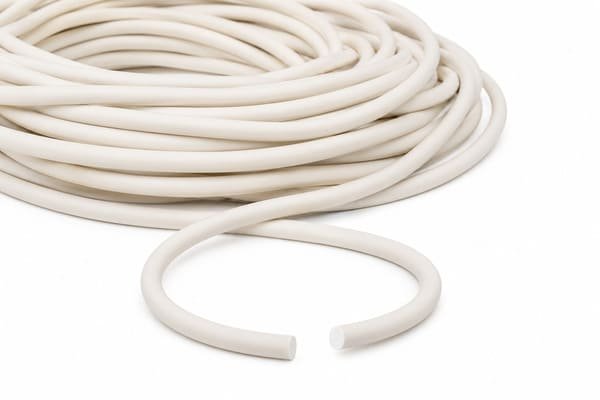
High temperature silicone sponge cord is a flexible round profile used for compressible sealing, cushioning, and gap filling in heated equipment. The pictured cord has an off-white surface and a cellular silicone sponge structure. Cord diameter, density, hardness, temperature rating, tolerance, and supply length are available upon request.
Product Overview
Silicone sponge cord is manufactured through an extrusion process that introduces a blowing agent into the silicone rubber compound, producing a cellular, closed-pore internal structure rather than the dense, solid cross-section found in standard silicone rubber cord. This cellular construction gives the cord significantly greater compressibility than solid cord of equivalent diameter, allowing it to form an effective seal under much lower clamping force. The natural off-white or light cream appearance shown in coiled bulk supply rolls is typical of unpigmented silicone sponge cord before any custom color matching is applied for specific customer or industry requirements.
Key Material Specifications
| Property | Typical Value |
|---|---|
| Material Type | Silicone rubber, closed-cell sponge structure |
| Temperature Range | Approximately -60 degrees Celsius to 230 degrees Celsius, with select formulations rated for intermittent exposure above 300 degrees Celsius |
| Density | Approximately 200 to 600 kilograms per cubic meter depending on sponge firmness grade |
| Hardness | Very soft, typically in the low single-digit Shore A range for standard sponge grades |
| Water Absorption | Less than 1 percent, supporting reliable performance in humid or wet environments |
| Compression Set | Low, generally under 5 percent under standard testing conditions |
| Elongation at Break | Approximately 145 percent for standard sponge cord formulations |
Why B2B Buyers Specify Silicone Sponge Cord Over Solid Rubber Alternatives
Procurement teams sourcing gasketing materials for enclosures, industrial equipment, and high-temperature machinery frequently select silicone sponge cord because it delivers a reliable seal using substantially less closure force than solid rubber or solid silicone cord of comparable size. This lower force requirement reduces mechanical stress on surrounding hardware, latches, and fasteners, which is a meaningful consideration for buyers designing lightweight enclosures or equipment where excessive clamping pressure risks long-term structural fatigue. Additionally, silicone’s inherent resistance to ultraviolet exposure, ozone, and general weathering supports long field service life, reducing the frequency and cost of gasket replacement across large equipment fleets or long-term installations.
Sourcing Considerations for Bulk and Custom Orders
Buyers evaluating silicone sponge cord suppliers for bulk procurement should confirm the specific temperature rating required for their application, since continuous-use ratings and intermittent peak exposure ratings can differ substantially between formulations. Cord diameter, density grade, and cut length tolerances should also be specified clearly in purchase orders, as sponge density directly affects both compressibility and long-term sealing performance under repeated compression cycles. For custom color-matched orders or private-label packaging requirements, working directly with the manufacturer during specification review helps ensure the finished cord meets both technical performance requirements and any branding or documentation standards required for the buyer’s end market.
Chemical Resistance and Application Limitations
While silicone sponge cord performs reliably across a wide temperature range and resists weathering and ozone exposure well, it is not recommended for applications involving direct, sustained contact with oils, solvents, or concentrated acids and alkalis, since these substances can cause swelling or gradual degradation of the silicone matrix. Buyers specifying this material for oil-adjacent or chemically exposed environments should request compatibility data specific to their process fluids before finalizing large-volume orders, since material substitution after production has begun can be costly and time-consuming.
Common Applications
- Industrial oven, furnace, and appliance door seals requiring stable performance across repeated high-temperature heating cycles.
- Outdoor telecommunications and electronics enclosure gasketing, benefiting from weather resistance and minimal water absorption.
- HVAC and ductwork sealing applications requiring a compressible, low-closure-force gasket material.
- Food processing and packaging equipment seals where compliance with food-contact material standards is required.
- General industrial equipment access panels and cabinet doors requiring a durable, long-life sealing solution.
Frequently Asked Questions
What temperature can silicone sponge cord withstand?
The exact continuous and intermittent temperature ratings have not been provided. They depend on the selected silicone compound, density, curing system, exposure duration, compression, and operating environment. Please provide the actual temperature cycle before material selection.
Can the cord diameter be customized?
Custom cord diameters can be evaluated upon request. Provide the required diameter, tolerance, groove dimensions, assembled gap, and target compression. These details help determine whether the cord can be installed without excessive force or insufficient sealing pressure.
What is the difference between silicone sponge cord and solid silicone cord?
Silicone sponge cord has a cellular interior and generally requires less force to compress than a similar solid cord. Solid silicone cord has a dense cross-section. The correct option depends on the joint gap, closing force, compression requirement, pressure, and sealing conditions.
Can silicone sponge cord be supplied as joined gasket rings?
Joined rings and other fabricated shapes can be evaluated upon request. Please provide the finished inside dimensions, cross-sectional diameter, joint location, dimensional tolerance, required quantity, and operating conditions. Joint performance should be confirmed for dynamic or pressure-sensitive applications.
Is this silicone sponge cord food-contact or flame-resistant?
No food-contact or flame-resistance compliance has been confirmed for this product. If a regulated application is involved, specify the exact standard and required documentation before quotation. A suitable compound and finished-part verification must then be reviewed separately.
What are the MOQ, sample availability, and lead time?
MOQ, sample availability, and lead time are available upon request. They depend on the required diameter, material formulation, density, hardness, color, tolerance, quantity, packaging format, and whether custom tooling or joining is required.
Request Product Evaluation
Provide the required cord diameter, tolerance, density, hardness, temperature exposure, groove dimensions, compression level, contact media, length format, and estimated quantity. A drawing, physical sample, or assembly detail will help evaluate the material specification, manufacturing feasibility, prototype requirements, packaging, and expected sealing conditions.