Product Overview
Reliable custom rubber parts for industrial applications
Quick Answer
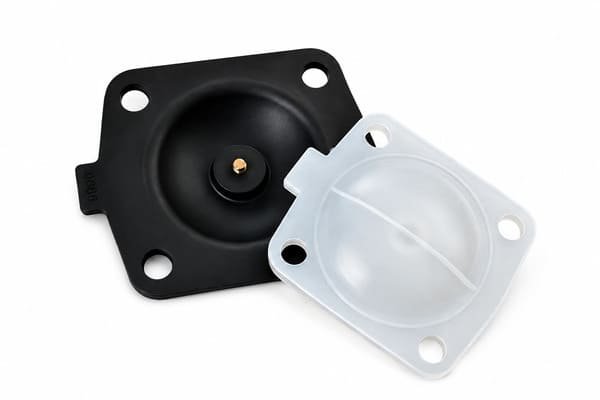
A square rubber diaphragm combines a flexible central membrane with a square perimeter for clamping in non-circular equipment housings. Length, width, thickness, corner geometry, material, Shore A hardness, membrane profile, mounting holes, and tolerances can be customized for valves, pumps, regulators, actuators, and control equipment.
A square rubber diaphragm is a flexible sealing and movement-control component designed for equipment with square or rectangular mounting interfaces. It can separate chambers, respond to pressure changes, transfer force, or change chamber volume. Length, width, thickness, corner geometry, rubber material, Shore A hardness, and mounting features can be customized according to the application.
Square Rubber Diaphragm — Precision Molded for Non-Circular Housing Designs
A square rubber diaphragm is a flexible molded membrane produced in a square or rectangular profile rather than the more common circular shape, designed to fit housings, valve bodies, or enclosures where a non-round footprint better matches the surrounding equipment geometry. These diaphragms perform the same core function as circular designs—flexing to separate chambers, transmit pressure, or control fluid and air flow—but their corner geometry requires careful mold and compound design to avoid stress concentration at the corners during repeated flexing. Square and rectangular diaphragms are typically custom-engineered to a specific housing drawing rather than sourced from generic stock sizes, since standardized square diaphragm dimensions are far less common across the industry than circular equivalents.
Key Specifications
| Parameter | Typical Range/Option |
|---|---|
| Available Materials | EPDM, NBR (Nitrile), Silicone, Viton (FKM), Neoprene (CR) |
| Shape | Square or rectangular, flat or slightly domed profile |
| Corner Design | Radiused corners to reduce stress concentration during flexing |
| Hardness Range | Typically 40–80 Shore A, depending on application |
| Mounting Style | Perforated bolt-hole flange, adhesive/bonded edge, or clamped frame edge |
| Thickness Range | Custom, typically 0.5mm–6mm depending on application |
| Manufacturing Process | Compression molding, transfer molding |
| Common Applications | Custom enclosures, rectangular valve housings, pressure switches, sensor diaphragms |
What Is a Square Rubber Diaphragm?
A rubber diaphragm, regardless of shape, is a flexible elastic membrane that flexes back and forth to separate two chambers while transmitting pressure, vacuum, or fluid movement without a direct mechanical linkage between the two sides. A square rubber diaphragm performs this same function but is molded to match equipment with a square or rectangular housing footprint, which is common in certain pressure switches, custom enclosures, and compact valve designs where a rectangular envelope makes more efficient use of available space than a circular one. Because the flexing behavior of rubber is naturally more uniform in a circular shape, square diaphragm designs require additional engineering attention at the corners, where bending stress tends to concentrate more than along the flat edges.
Engineering Considerations for Square Diaphragms
- Corner radius design — sharp 90-degree corners create stress concentration points during repeated flexing, so square diaphragms are typically molded with a generous corner radius to distribute bending stress more evenly and extend fatigue life.
- Directional flex behavior — unlike a circular diaphragm that flexes symmetrically in all directions, a square diaphragm flexes differently along its edges versus its corners, which must be accounted for in stroke and displacement calculations.
- Reinforcement placement — fabric reinforcement, when used, may need to be oriented or layered differently in a square design compared to a circular one to provide balanced support across both the straight edges and the corner regions.
- Mold complexity — square and rectangular mold cavities with tight corner tolerances generally require more precise tooling than round cavities to avoid flash or incomplete fill at the corners during molding.
Available Materials and Their Properties
| Material | Key Properties | Typical Applications |
|---|---|---|
| EPDM | Excellent weather, ozone, and steam resistance; good low-temperature flexibility | Outdoor enclosures, HVAC control components |
| NBR (Nitrile) | Strong oil and fuel resistance | Automotive and hydraulic component housings |
| Silicone | Wide temperature range, excellent flexibility, food and medical grade options | Medical devices, sensor housings, food equipment |
| Viton (FKM) | Superior chemical and high-temperature resistance | Chemical processing enclosures |
| Neoprene (CR) | Balanced resistance to oil, weather, and moderate chemicals | General industrial equipment |
Material selection for square diaphragms follows the same fluid, temperature, and chemical compatibility principles as circular diaphragms, since shape does not change a compound’s chemical resistance properties.
Mounting and Edge Options
- Perforated bolt-hole flange — a rectangular ring of bolt holes around the perimeter for clamped installation between two square housing halves, similar in principle to a circular flanged diaphragm.
- Bonded/adhesive edge — the diaphragm edge is bonded directly to a square frame or housing lip, used where bolted clamping is impractical due to space constraints.
- Clamped frame edge — the diaphragm is held in place by a separate frame or retaining plate that compresses the edge against the housing without through-bolts.
- Center attachment features — molded center holes or bonded inserts for connecting the diaphragm to an internal stem, piston, or sensor element, matching the same principle used in circular diaphragm designs.
Manufacturing Process
Square rubber diaphragms are produced using compression molding or transfer molding, where the rubber compound is cured under heat and pressure within a precision-machined square or rectangular mold cavity. Achieving consistent wall thickness and flash-free corners requires tighter process control than typical circular molds, since material flow behaves differently as it fills the corner regions of a square cavity compared to the uniform radial flow in a round one. Fabric reinforcement, where specified, is cut and positioned to follow the diaphragm’s rectangular geometry, with particular attention paid to ensuring adequate coverage and bonding at the corner regions where stress concentration is highest.
Common Applications
- Custom pressure switches and sensor housings with a rectangular footprint.
- Compact valve or actuator designs where square housings make more efficient use of available installation space.
- Specialty enclosures requiring a flexible sealing or pressure-sensing membrane matched to a non-round frame.
- OEM equipment where the diaphragm must match an existing square or rectangular housing design rather than requiring a housing redesign around a standard round diaphragm.
- Custom industrial components where a square diaphragm simplifies integration with surrounding rectangular structural elements.
Custom Manufacturing Options
- Custom overall dimensions and corner radius engineered to match customer housing drawings.
- Custom rubber compound selection based on chemical, temperature, or food/medical compliance requirements.
- Custom flange bolt-hole pattern, bonded edge, or clamped frame design to match specific mounting needs.
- Custom fabric reinforcement layout adapted to the square/rectangular geometry.
- Custom durometer (hardness) selection to balance flexibility and durability for the specific application.
- Reverse-engineering service to reproduce square diaphragms from a sample part or drawing.
- Prototype and low-volume sampling available prior to full production tooling commitment.
FAQ
Can the length and width be customized?
Yes. Length, width, thickness, corner radius, sealing edge, bolt pattern, and membrane geometry can be customized for the equipment housing. Critical dimensions, clamping areas, tolerances, and available movement space should be identified before tooling development.
Why is corner geometry important?
Corner geometry affects installation fit, clamping compression, membrane movement, and stress distribution. An unsuitable corner radius or edge transition may cause folding, interference, uneven sealing, or localized strain. The diaphragm corners must match the mating housing and clamping structure.
How should the rubber material be selected?
Material selection depends on the contact fluid or gas, operating temperature, pressure, cycling frequency, and environmental exposure. Complete service conditions should be reviewed before the rubber compound and Shore A hardness are confirmed. Material compatibility may require application-specific testing.
Can a physical sample be used for development?
Yes. A physical sample can support dimensional and structural evaluation. Application conditions and any available material information should also be provided. Wear, swelling, hardening, tearing, or permanent deformation must be considered when measuring a used diaphragm.
Are prototype samples available?
Sample availability depends on the diaphragm structure, rubber compound, tooling requirements, and quantity. Initial samples can be arranged after technical review. Dimensions, installation fit, perimeter sealing, membrane movement, hardness, and functional acceptance criteria should be defined before approval.
How are tooling, MOQ, and lead time confirmed?
Tooling, MOQ, and lead time depend on the square diaphragm dimensions, membrane structure, rubber compound, inspection requirements, sample approval process, and order quantity. These details are confirmed after reviewing the complete technical specification and estimated annual demand.
Request a Custom Quote
Send your 2D drawing, 3D model, or physical sample for a square rubber diaphragm quotation. Include dimensions, corner geometry, tolerances, contact media, temperature, pressure, movement conditions, material requirements, Shore A hardness, quantity, and estimated annual volume. Tooling, samples, MOQ, lead time, and documentation will be confirmed after technical review.
Product Subtitle:
Short Description:
Material: Available upon request. Material selection depends on contact media, operating temperature, pressure, movement frequency, and environmental exposure. Custom compounds are available based on application requirements.
Application / Use Case:
SEO Title:
Meta Description: