Product Overview
Reliable custom rubber parts for industrial applications
Quick Answer
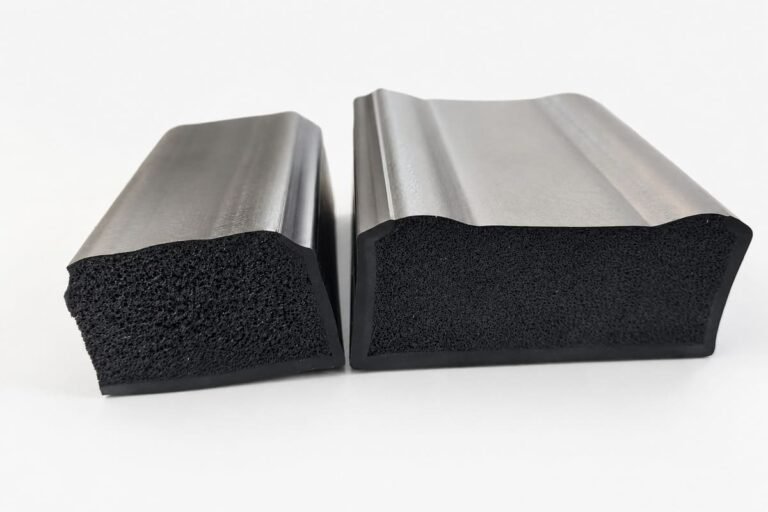
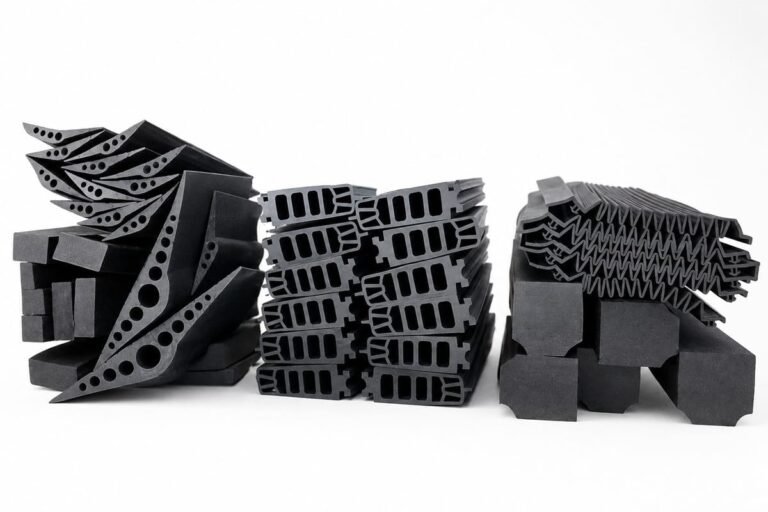
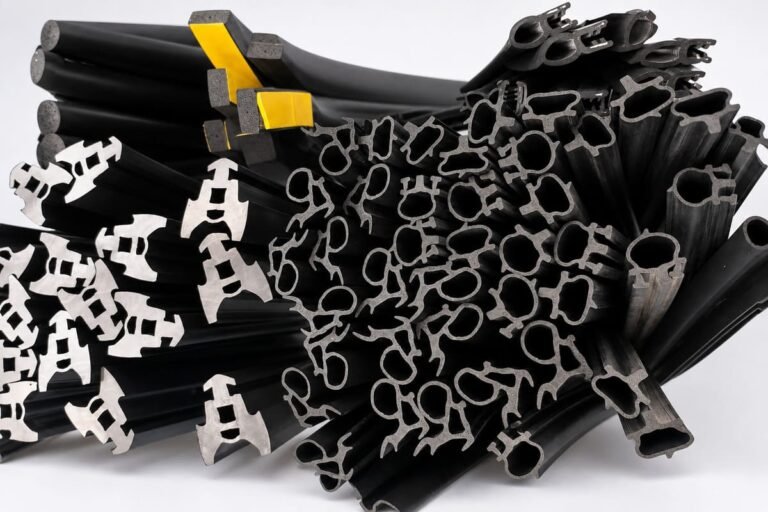
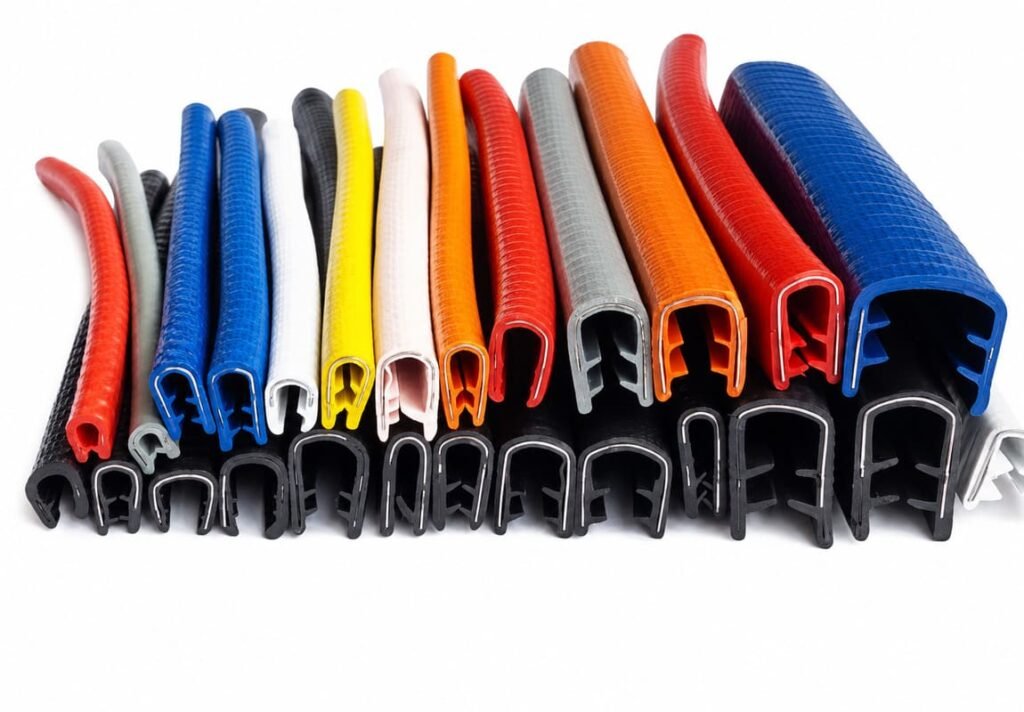
Rubber sealing strips for new energy vehicles and buses are continuous profiles installed around body openings and equipment interfaces. The pictured range includes multicolor profiles with hollow bulbs, flexible lips, channel bases, and different cross-sections. Material, hardness, dimensions, tolerances, compression requirements, and validated sealing performance are available upon request. Custom Rubber Sealing Strips for New […]
Rubber sealing strips for new energy vehicles and buses are continuous profiles installed around body openings and equipment interfaces. The pictured range includes multicolor profiles with hollow bulbs, flexible lips, channel bases, and different cross-sections. Material, hardness, dimensions, tolerances, compression requirements, and validated sealing performance are available upon request.
Custom Rubber Sealing Strips for New Energy Vehicles and Buses
These sealing strips are produced through a continuous extrusion process that shapes EPDM rubber compound into precise cross-sectional profiles matched to the specific door, window, or panel gap they are designed to seal. The colorful strip variations commonly seen across production samples typically represent different cross-sectional designs, such as bulb seals, D-shaped profiles, and channel-style seals, each engineered for a specific mounting location and sealing function on the vehicle body.
Key Features
- Extruded from EPDM rubber compound, offering strong resistance to ultraviolet exposure, ozone, and general weathering over extended outdoor service.
- Available in multiple profile shapes, including bulb seals, D-shaped seals, and channel-style seals, matched to specific door, window, or trunk sealing locations.
- Engineered to maintain flexibility and sealing performance across a broad temperature range encountered in varied climate and seasonal conditions.
- Designed for reliable performance under frequent door cycling, a common requirement for buses and transit vehicles with high passenger turnover.
- Available with or without embedded metal or fabric reinforcement, depending on the specific structural and sealing requirements of the mounting location.
- Compatible with adhesive-backed, clip-mounted, or friction-fit installation methods depending on the specific vehicle door or window design.
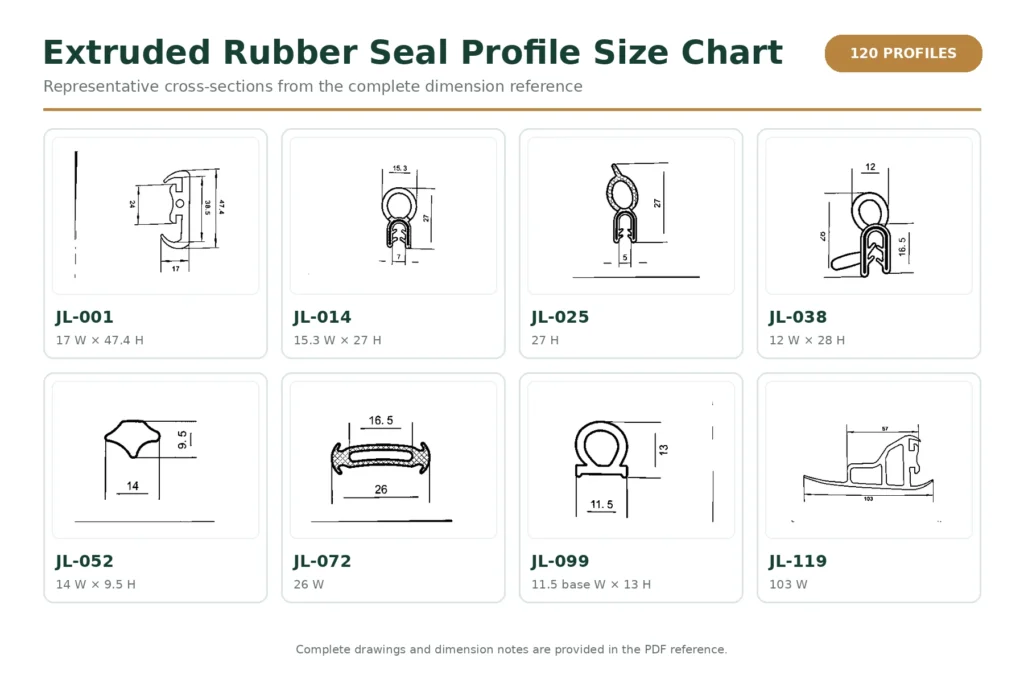
Extruded Rubber Seal Profile Size Chart
The profiles below cover clip-on edge trims, bulb seals, wiper profiles, glazing sections and complex extruded sealing profiles. All dimensions are nominal reference values in millimetres and should be confirmed against the final application drawing or physical sample.
Customizable Specifications
| Specification | Available Options |
|---|---|
| Material | EPDM, silicone/VMQ, NBR, CR, SBR, TPE or TPV, selected for the operating environment |
| Profile construction | Solid rubber, sponge rubber, solid-and-sponge co-extrusion, hollow bulb, lip seal, or metal-carrier clip-on profile |
| Hardness and density | Customized according to compression force, sealing pressure, recovery and installation requirements |
| Supply form | Continuous coils, straight lengths, cut-to-length pieces, vulcanized rings, or corner-jointed frames |
| Color and surface | Black or custom colors; optional low-friction coating, flocking or application-specific surface treatment |
| Tolerance | Confirmed according to profile geometry, material, process capability and the approved technical drawing |
Why EPDM Is the Preferred Material for Vehicle Sealing Applications
EPDM rubber is widely selected for automotive and bus sealing strips because it combines strong resistance to ultraviolet degradation, ozone exposure, and general weathering with the flexibility needed to maintain a consistent seal across repeated door and window movement cycles. This weather resistance is particularly important for new energy vehicles and buses, which often operate on fixed daily routes across a wide range of climate conditions and require seals capable of performing reliably through repeated seasonal temperature swings without cracking or losing elasticity. EPDM’s long-established use in the broader automotive weatherstripping industry also means its performance characteristics are well documented and its manufacturing processes are highly refined for consistent, repeatable extrusion quality.
Sealing Performance and Design Considerations
The specific profile shape selected for a given sealing location directly affects how effectively the strip blocks water, dust, wind, and noise from entering the vehicle interior. Bulb-style seals are commonly used along door edges, where the hollow, rounded bulb section compresses against the mating surface to form a tight seal while allowing the door to close without excessive resistance. D-shaped and channel-style profiles are frequently applied to window sealing and trunk or panel edge applications, where a flatter sealing surface and structural channel help the strip grip securely onto the vehicle body edge. Selecting the correct profile, dimension, and mounting method for each specific sealing location is essential to achieving both an effective seal and a secure, long-lasting installation.
Application Considerations for Fleet and Transit Vehicles
New energy vehicles and buses generally experience significantly higher daily door cycling than typical passenger cars, particularly on transit routes with frequent passenger boarding and alighting, making long-term fatigue resistance a critical performance factor for these sealing strips. Consistent sealing performance also plays a role in interior climate control efficiency, since a compromised door or window seal can allow conditioned air to escape and outside air to intrude, increasing the energy load on the vehicle’s climate control system. For fleet operators managing multiple vehicles across varied operating environments, selecting sealing strips engineered for both mechanical durability and long-term weather resistance helps reduce the frequency of seal-related maintenance across the vehicle’s operational lifespan.
Common Applications
- Door edge and door frame sealing for new energy electric vehicles and passenger buses.
- Window and window frame sealing profiles, blocking water intrusion and reducing road noise transmission into the cabin.
- Trunk, luggage compartment, and access panel sealing across bus and coach body designs.
- General transit vehicle body sealing applications requiring long-term weather and fatigue resistance under frequent daily use.
Frequently Asked Questions
Which rubber material is suitable for vehicle sealing strips?
Material selection depends on temperature, weathering, ozone, moisture, chemicals, compression, movement, and required service conditions. The compound cannot be confirmed from appearance alone. Complete environmental and performance requirements should be provided before material selection.
Can the cross-sectional profile be customized?
Custom profile width, height, lips, bulbs, cavities, channels, wall thickness, and retention features can be evaluated. Provide the mating geometry, installation gap, compression range, flange thickness, and required function before the cross-section is finalized.
Can solid and sponge rubber be combined in one sealing strip?
A combined solid and sponge construction can be evaluated when different areas require retention strength and compressibility. The required density, hardness, compression force, recovery, joining structure, and service environment must be confirmed for each functional section.
Can these profiles be used for battery enclosure sealing?
Battery enclosure applications can be evaluated, but suitability requires confirmed compression, joint continuity, corner design, water and dust requirements, temperature exposure, chemical contact, electrical requirements, and applicable validation methods. The complete enclosure assembly should be tested before approval.
How should vehicle sealing performance be validated?
Validation should reflect the installed assembly and may include dimensional fit, insertion force, compression load, recovery, retention, leakage, acoustic behavior, aging, and environmental exposure. The required standards, test conditions, and acceptance criteria must be agreed before production.
What are the tooling, sample, MOQ, and lead-time requirements?
Tooling, sample availability, MOQ, and lead time are available upon request. They depend on the profile geometry, material structure, hardness, density, color, tolerance, joining process, quantity, validation requirements, and packaging specification.
Request Product Evaluation
Provide the seal cross-section, assembly dimensions, installation gap, flange geometry, material requirements, compression range, environmental conditions, joining details, validation criteria, and estimated quantity. A drawing, model, physical sample, or vehicle interface detail will help evaluate the profile structure, tooling, prototype requirements, manufacturing feasibility, and inspection plan.