Product Overview
Reliable custom rubber parts for industrial applications
Quick Answer
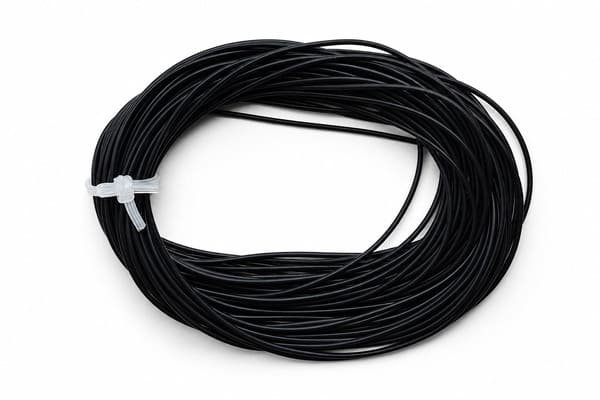
Black solid silicone rubber cord is an extruded round-profile elastomer cord for compression sealing, cushioning, gap filling, insulation support and gasket fabrication. Diameter, cut length, coil length, joined ring size, Shore A hardness, tolerance, packaging and documentation options are available upon request.
Black solid silicone rubber cord is an extruded round elastomer profile used for sealing, cushioning, insulation support, gap filling and custom gasket fabrication. The solid cross-section provides flexible contact and compression support in compatible assemblies. Diameter, cut length, coil length, Shore A hardness, tolerance, packaging and compliance documentation are available upon request.
Black Solid Silicone Rubber Cord Coil — Glued Closed-Loop Sealing Ring
The Black Solid Silicone Rubber Cord Coil is a closed-loop sealing ring formed by joining a continuous solid silicone rubber cord end-to-end using a soft gluing point technique, producing a seamless ring without a raised or protruding seam. Manufactured in black with a reference ring length of 920mm and a solid silicone compound at 51 Shore A hardness, this cord ring is designed for gasket and sealing applications requiring a consistent, closed cross-section seal.
Key Specifications
| Parameter | Specification |
|---|---|
| Construction | Solid silicone cord, glued into a closed ring (soft gluing point) |
| Ring Length (Circumference) | 920 mm (± 3 mm) |
| Thickness Tolerance | +2.5 / -0.2 mm |
| Material Type | Solid silicone rubber |
| Hardness | 51 ± 5 Shore A |
| Compound Reference | GF 153 |
| Color | Black |
| General Tolerance (unspecified dimensions) | DIN ISO 3302-1 Class E2 |
| Customs/Tariff Code | TARIC-No. 3926 9097 900 |
What Is a Solid Silicone Rubber Cord Coil?
A solid silicone rubber cord coil is a closed-loop sealing ring produced by extruding a continuous solid silicone cord and joining the two ends together using a soft gluing point, a bonding technique designed to create a smooth, low-profile splice rather than a hard, raised seam. This reference configuration measures 920mm in overall ring length (± 3mm) with a thickness tolerance of +2.5/-0.2mm, and is molded from a solid (non-sponge) silicone compound at 51 ± 5 Shore A hardness. Unlike sponge or cellular silicone cord rings, a solid cross-section provides a denser, more consistent sealing surface, making it well suited to applications requiring predictable compression force and long-term dimensional stability.
Dimensional Profile
| Feature | Reference Value |
|---|---|
| Ring length (circumference) | 920 mm ± 3 mm |
| Thickness tolerance | +2.5 mm / -0.2 mm |
| Hardness | 51 ± 5 Shore A |
| General tolerance for unspecified dimensions | DIN ISO 3302-1 Class E2 |
| Joint type | Soft gluing point splice |
The soft gluing point construction method allows the joint to blend smoothly into the cord’s cross-section, minimizing any discontinuity in the sealing surface at the splice location compared to a standard butt-glued joint.
Material Properties: Solid Silicone Rubber
The cord coil is produced from a solid silicone rubber compound identified under compound reference GF 153, offering the following general performance characteristics typical of solid silicone rubber sealing cords.
- Consistent Hardness: Manufactured to 51 ± 5 Shore A, providing a predictable, moderate compression force suitable for general gasket sealing duty.
- Solid Cross-Section Density: Unlike sponge/cellular silicone, the solid structure delivers a denser, more uniform sealing surface with stable long-term compression performance.
- Dimensional Stability: Tight thickness tolerance (+2.5/-0.2mm) and adherence to DIN ISO 3302-1 Class E2 general tolerances support consistent sealing performance across production batches.
- Color Consistency: Manufactured in black for consistent appearance and easy visual identification.
Key Features
- Solid silicone cord glued into a closed ring using a soft gluing point technique for a smooth splice.
- Reference ring length of 920mm with tight ± 3mm length tolerance.
- Solid (non-sponge) 51 ± 5 Shore A hardness for consistent sealing compression.
- Thickness held to a tight +2.5/-0.2mm tolerance band.
- Manufactured to DIN ISO 3302-1 Class E2 general tolerance standard for all unspecified dimensions.
- Consistent black color across production batches.
- Classified under TARIC customs code 3926 9097 900 for trade documentation purposes.
Common Applications
- Gasket sealing rings for enclosures, covers, and access panels requiring firm compression sealing.
- Static sealing rings for equipment housings and junction boxes.
- Cushioning and sealing rings in electrical or electronic assembly applications.
- General industrial sealing where a custom-length solid cord ring is more practical than a molded O-ring.
- Applications requiring a denser, higher-compression-force alternative to sponge cord rings.
Why Choose a Glued Solid Cord Ring
Producing a sealing ring by joining a continuous solid silicone cord to length with a soft gluing point offers significant flexibility for custom ring circumferences without the tooling cost of a dedicated compression mold for each diameter. The solid cross-section, combined with a controlled 51 ± 5 Shore A hardness, provides firmer compression sealing than a sponge equivalent, making this construction method a practical way to supply consistent, mid-hardness sealing rings across a wide range of lengths from standard extruded cord stock.
Custom Manufacturing Options
- Custom ring length (circumference) to match specific application dimensions.
- Custom cord cross-section diameter beyond the standard reference.
- Custom hardness grade outside the 51 ± 5 Shore A range for different compression requirements.
- Custom color beyond standard black.
- Custom compound selection for specific temperature or chemical resistance needs.
FAQ
What is black solid silicone rubber cord used for?
Black solid silicone rubber cord is used for compression sealing, cushioning, gap filling, insulation support, gasket fabrication and general industrial assembly. It is commonly installed in grooves, between mating surfaces or around equipment covers when a flexible round cord profile is required.
Can the cord diameter be customized?
Yes. Cord diameter is available upon request. Diameter selection should match the groove size, mating gap and required compression rate. Accurate diameter confirmation is important because sealing performance and installation force depend on the cord geometry.
Can black silicone cord be supplied in coils or cut lengths?
Yes. Black solid silicone rubber cord can be supplied in coils, reels, cut lengths or customer-defined packaging formats. The correct supply format depends on the assembly process, warehouse handling, packing quantity and production line requirements.
Can the cord be joined into rings?
Joined rings can be reviewed when the cord needs to function as a round-profile gasket. Ring size, joining method, joint strength, tolerance and inspection requirements should be confirmed before production.
How should buyers select the silicone hardness?
Shore A hardness should be selected according to compression force, flexibility, rebound behavior and installation method. A softer compound can compress more easily, while a harder compound may provide firmer support. Final selection depends on the actual application conditions.
Are compliance documents available?
RoHS, REACH and other documentation options are available upon request for applicable silicone compounds. Buyers should confirm the required standard, market, contact media and documentation format before quotation, sampling or bulk production.
Request a Custom Quote
Send the confirmed black solid silicone rubber cord specification or physical sample for review. Please include diameter, hardness, length, tolerance, material requirement, application environment, contact media, quantity, annual demand, compliance requirements and packaging method.